

This newsletter is free and will stay free. If it's useful to you, a paid subscription is the best way to keep it going. —Luis G.

The U.S. journalism industry is cannibalizing its own workforce.
In the first three months of 2026, one of the country’s most storied newsrooms lost close to half its journalists in a single round of cuts. A 240-year-old daily announced it would stop publishing altogether. A broadcast network shut down a division that had been on the air since the 1930s. And across digital and local TV, outlets from Axios to Nexstar continued trimming staff with no sign of slowing down.
The pace of destruction is outrunning any effort to rebuild — and the pipeline that’s supposed to feed new talent into the profession is collapsing right alongside it.
🩺 The Pain Point
The talent pipeline is collapsing at every stage: experienced reporters are getting pushed out, entry-level pay is driving graduates away, and the midcareer layer that holds newsrooms together is thinning fast.
At the top, experienced journalists are being pushed out by rolling layoffs that have intensified sharply since 2018. Press Gazette’s 2026 tracker has already logged cuts at The Washington Post, Atlanta Journal-Constitution, Politico, Nexstar, Vox Media, Axios, CNBC, CBS News, and The Wall Street Journal — all by early spring.

Full-year journalism cuts reached at least 3,434 in the U.S. and U.K. in 2025. This year’s pace could very well eclipse those figures by this summer, according to The Media Copilot.
The Washington Post alone eliminated roughly 350-375 newsroom positions in February — about half of its staff, according to the labor union that represents its journalists — shuttering its sports section, books desk, and large parts of its foreign and metro coverage.
The Pittsburgh Post-Gazette, in continuous operation since 1786, will publish its final edition on May 3, wiping out roughly 170 jobs. On March 20, CBS News killed its nearly century-old radio division and cut about 60 staffers.
A dark year for storied journalism indeed.
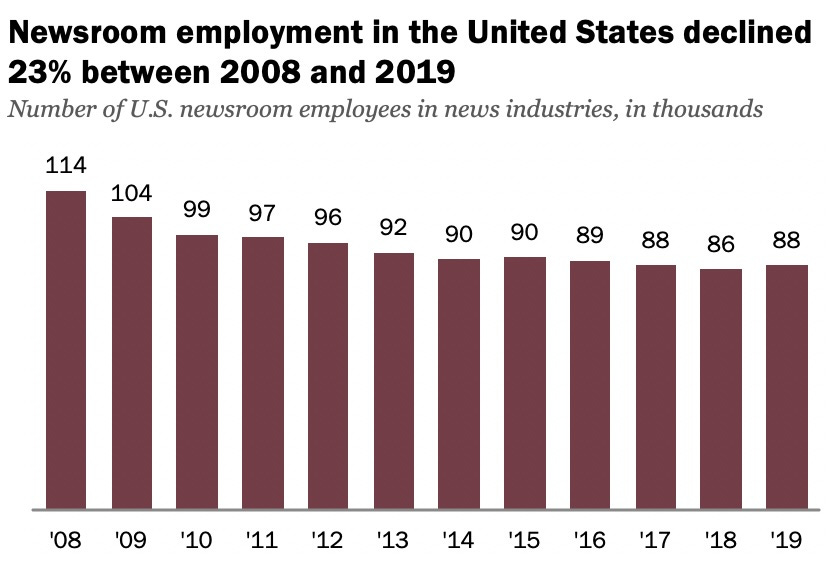
However, all of these layoffs track with trends those of us in the industry have been witnessing for some time now. A Columbia Journalism Review analysis found that more than 8,200 U.S. journalists have been laid off since 2022 — about 9% of the entire workforce. This year’s bloodletting may put that at a higher figure.
Pew Research found in a 2020 analysis that the decade-long decline between 2008-2018 hit midcareer workers ages 35–54 the hardest, something I’d liken to stripping out the institutional knowledge that holds newsrooms together.
At the bottom, the entry-level wage math is brutal. The Bureau of Labor Statistics reports the lowest 10% of reporters earned under $34,590 in May 2024.
Georgetown University’s Center on Education and the Workforce found that journalism graduates earn a median of just $39,700 net of student loan debt three years out — ranking 14th out of 34 major groups — and only about 15% of journalism majors end up working in the field early in their careers. The profession is asking people to take a pay cut for the privilege of entering it.
And the pool of people willing to make that bet is shrinking.
Undergraduate enrollment in journalism and mass communication programs dropped 16.3% between 2013 and 2015, and the trajectory hasn’t reversed. Bachelor’s degrees awarded in journalism have declined 25% since their early-2010s peak, according to the Georgetown Center on Education and the Workforce. The occasional ‘Trump bump’ in j-school interest has never been matched by an improvement in the economic logic of actually taking a journalism job.
Meanwhile, the number of U.S. high school graduates is expected to peak around 2025–2026 and then fall roughly 13% by 2041, meaning journalism programs will be fighting for students from a shrinking pool — students who can see the layoff headlines as clearly as anyone.
🔴 Pain Point Score: HIGH
This is a crisis-level structural failure.
Unlike a single round of layoffs or a single paper’s closure, the pipeline collapse threatens the industry’s ability to staff any beat, anywhere, for the foreseeable future. Every other problem I’ve covered on this newsletter — the sports gap, the paywall paradox — is downstream of this one.
📊 Why It Matters
Every outlet in the pain point section above had one thing in common: the journalists who left were replaced by nothing — no new hires, no alternative coverage plan, just gaps where reporting used to be.
What fills the gap is worse than the gap itself: press releases published as news, partisan operatives with Substacks and production budgets, AI-generated content farms optimized for engagement, and public officials who now operate in communities where no one is paid to check what they say.
The pipeline collapse is beyond just a labor market story. It is a transfer of narrative power from trained, accountable reporters to actors with no obligation to accuracy and no professional consequences for getting it wrong.
And the public can feel it.
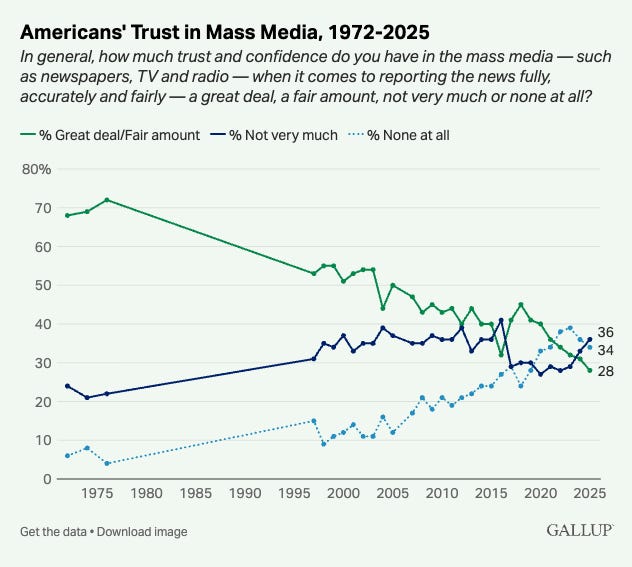
Gallup’s annual trust survey shows confidence in mass media at just 28% as of 2025 — a record low. A separate Pew Research Center survey found that trust in national news organizations has fallen 20 percentage points since 2016, with less than half of Republicans and Republican-leaning independents expressing any trust at all. These numbers track closely with the acceleration of newsroom cuts.
Fewer journalists means thinner coverage, which means less public value and fewer subscribers, and ultimately more cuts.
Meanwhile, the information vacuum left behind becomes a growth market for misinformation, political propaganda, and algorithmic content that looks like journalism but operates without any of its constraints. Every closed newsroom is a new unmonitored zone.
The democratic cost is concrete and measurable. A landmark study found that newspaper closures lead to higher municipal borrowing costs — 5 to 11 basis points per bond issue — higher government wages and deficits, costing taxpayers an estimated $650,000 per bond issue (Read the full study here).
That means that when no one is watching, officials spend more, disclose less, and face fewer consequences. The communities losing coverage the fastest are the ones that can least afford it.
To put it succinctly, the pipeline problem documented above is a structural failure in the country’s information infrastructure — and the people who will pay the highest price are the ones who never subscribed to a newspaper in the first place.
🤔 Who Should Care
» Newsroom leaders facing hiring gaps on critical beats.
» J-school administrators watching enrollment erode.
» Funders and philanthropy officers deciding where to direct local news investment.
» Developers and civic technologists looking for infrastructure gaps to fill.
» Policymakers weighing whether the government has a role in sustaining local journalism employment.
🏗️ The Structural Root Cause
This is a compounding structural failure at every stage of the talent pipeline.
The midcareer hollowing-out has a specific consequence that gets less attention: the editor pipeline is breaking. A survey of 116 editors conducted by Bettina Chang during her JSK Fellowship at Stanford found that the vast majority cited a lack of formal training, barriers to advancement, and unclear success metrics.
The reporter-to-editor pathway that newsrooms have relied on for decades has almost no institutional training behind it — only a few large organizations (Dow Jones News Fund, The New York Times, NPR, ProPublica) invest in formal editor development. When experienced editors get laid off, the mentorship and quality control they provided leaves with them — and there’s no program replacing it at scale.
AI is also having an impact on the pipeline by accelerating displacement. Axios publisher Nicholas Johnston said the company was “starting to see how AI can help us automate some tasks to focus humans on our most consequential work.”
The Washington Post’s executive editor cited the collapse of organic search traffic — down nearly half in three years — and the rise of AI-generated content as key factors in the restructuring.
Meanwhile, media workers are pushing harder for guaranteed severance packages as layoffs feel inevitable amid consolidation.
The result is a field that is simultaneously losing experienced professionals to layoffs, losing entry-level talent to better-paying industries, and facing a shrinking pool of students willing to enter the profession at all.
💡 Who’s Solving It (+ How)
The people working on the pipeline problem are scattered across universities, nonprofits, state legislatures, and newsrooms that are themselves under threat. What connects them is a shared read: the market alone won’t fix this, and neither will journalism schools or philanthropy acting in isolation. The efforts worth watching have moved past diagnosis and into implementation.
✧

Report for America is scaling the most proven pipeline intervention in the country. The national service program announced its 2026 newsroom partners in January, with plans to place more than 200 corps members in local newsrooms by July 2026. By that point, RFA will have placed more than 850 journalists in 465 newsrooms since its first placements in 2018, and the organization reports that 81% of its alumni remain in journalism after completing the program.
In 2026, RFA introduced a sports corps (five positions covering community sports) and expanded its investigative reporting program, funded by Arnold Ventures, to support 48 local investigations over three years. RFA also launched a pilot in Central Kentucky with Press Forward Blue Grass to train non-traditional community journalists — a model for stackable-credential entry.
✧
The Illinois Local Journalism Tax Credit is the first state-level policy designed to directly subsidize journalism jobs. In its debut year (2025), the program awarded more than $4 million in tax credits to support more than 260 journalist positions at 55 news entities across more than 120 local outlets.
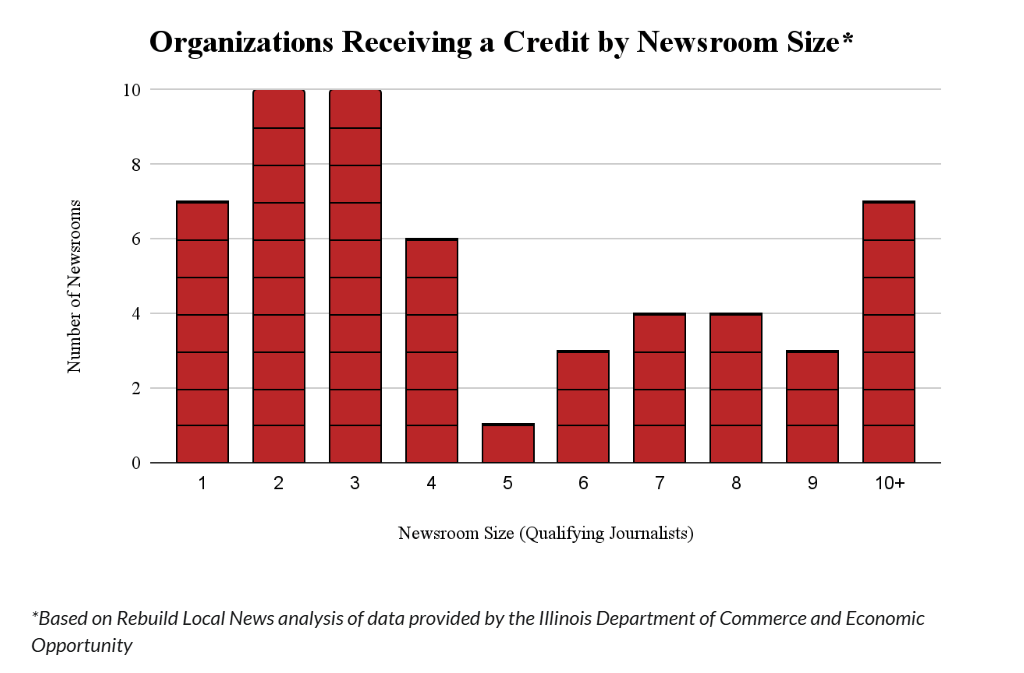
Two-thirds of recipients were newsrooms of six or fewer journalists. Rebuild Local News, which helped design the legislation, reports that the program reached a cross-section of commercial and nonprofit outlets statewide, and that its formula design raised no known allegations of officials picking winners or making content-based distinctions between outlets. The 2026 application window opened February 1.
✧
The nonprofit news sector is absorbing some displaced talent and growing — but unevenly. The 2025 INN Index found that 83% of local nonprofit news organizations increased revenue by at least 10% over three years, outpacing state, regional, and national outlets. Traffic to nonprofit news sites surged in Q4 of 2025, especially those covering immigrant communities amid heightened ICE enforcement.
But a field-level analysis of 559 Press Forward infrastructure funding proposals warns that nonprofit outlets have clustered in major metro areas, and that the communities most in need of subsidy are often the least likely to have philanthropic access.
🔧 The Build Opportunity
The pipeline crisis documented above has a structural quality that makes it resistant to traditional fixes. You can’t recruit your way out of a pay gap, train your way past a demographic cliff, or fundraise your way into communities that lack philanthropic infrastructure.
But each of those failures points to a specific gap where a well-designed tool, policy model, or funding mechanism could change the math. The following build opportunities offer some solutions.
✧
Opportunity 1: A Shared Industry Talent Platform
No centralized tool exists to match laid-off journalists, career-switchers, and j-school graduates with newsrooms that have open beats — including the part-time, freelance, and contract roles that traditional job boards miss.
The Institute for Independent Journalists tracks layoffs and surveying displaced journalists, but there’s no CRM-style platform that reconnects that talent with the outlets that need it. There’s an opportunity for a two-sided marketplace for journalism labor, built around beats and geographies, not just job titles.
✧
Opportunity 2: Scalable Apprenticeship Infrastructure
Report for America proves the model works at scale, but its corps will reach around 200 members by July 2026 — a fraction of the 3,400+ jobs cut in the U.S. and the U.K. in 2025 alone.
What’s needed is federated apprenticeship infrastructure: a framework that lets regional press associations, community foundations, and nonprofit newsrooms stand up their own salary-subsidy programs using a shared playbook, shared recruitment tools, and shared outcomes tracking. The Kentucky pilot with Press Forward Blue Grass points in this direction.
✧
Opportunity 3: State-level Payroll Policy at Scale
Illinois proved that a journalism payroll tax credit can work without government content interference. Other states need replicable legislative templates and implementation guidance.
Rebuild Local News is already pushing bills in New Hampshire, Connecticut, Hawai’i, Maryland, and Washington. But the speed of adoption matters: every year without policy intervention is another year of compounding talent loss.

✧
Opportunity 4: Salary Benchmarking and Transparency Tools
Small publishers can’t compete for talent if they don’t know what the market pays. The Georgetown CEW report ranks 850 journalism and communication programs by graduate earnings — similar data is needed at the employer level.
An open, anonymous salary database for journalism — broken down by market size, beat, and experience level — would give newsroom leaders the benchmarks they need to write competitive offers and give job seekers the transparency they deserve.
💬 Closing Provocation
“All the strategies that we can throw at funding journalism are meaningless if the people are broken, if they cannot do the job.” — Meredith D. Clark, associate professor, UNC Hussman School of Journalism
⚡️ tl;dr
The U.S. journalism talent pipeline is breaking at every level. At the top, more than 8,200 journalists have been laid off since 2022. The Washington Post cut half of its newsroom in February. The Pittsburgh Post-Gazette is shutting down in May. CBS killed its radio division after 99 years.
At the bottom, entry-level pay starts below $35,000, only 15% of journalism majors end up working in the field, and the number of high school graduates feeding into college programs is about to drop for the next decade.
In the middle, the midcareer editors who hold newsrooms together are being cut fastest and replaced by nothing.
Gallup trust in media hit 28% in 2025. A growing body of research ties newspaper closures directly to higher costs for local taxpayers.
The nonprofit sector is growing but concentrated in metro areas with existing philanthropic networks, leaving the communities that need coverage most with the least access to funding. Illinois launched the first state-level journalism tax credit and got $4 million out the door in year one.
There's another effort that, when successful, could dramatically reduce the number of news deserts while also increasing direct support to newsrooms without the need for grants or adopting expensive technologies. I invite you to take a look at what we're doing at N2 Media Holdings and our project, 'The Local.' https://n2mediaholdings.com