

This newsletter is free and will stay free. If it’s useful to you, a paid subscription is the best way to keep it going. —Luis G.
American radio is dying faster, reaching populations newspapers never did, and getting a fraction of the coverage. And I think we have about five weeks before the most underreported structural media story of 2026 lands in everyone’s lap all at once.
The collapse is concentrated in places that had no fallback to begin with, and that geography is mostly absent from the national coverage. A metro desk cut in Cleveland or Denver still leaves residents with TV affiliates and a crowded field of digital startups competing for their attention.
If we are to have a serious conversation about the state of local news and the structural flaws that create news deserts, we must truly consider the cost of losing an essential medium to millions of Americans.
A small rural AM signal going dark in South Dakota or rural Alaska often leaves nothing behind it. Broadband does not reliably stream out there, cell coverage drops in the canyons, and the last weekly paper folded a decade ago. The AM signal was what was left. Federal funding was the thin subsidy keeping it lit, and that subsidy is now gone.
Strip out the public money and the network feed in the same year, and what disappears in rural America is the apparatus that carries wildfire evacuation orders and tornado warnings to households who cannot get them any other way. Journalism was bundled into that infrastructure, and most rural listeners could not separate the two if you asked them.
(Click here to skip to the TL;DR summary of this newsletter.)
🩺 The Pain Point
Local radio is suffering a blow from multiple directions inside the same 12 months, and it affects rural listeners the most.
On May 22, CBS News Radio will go off the air after 99 years in service, pulling national news off roughly 700 affiliated stations. Radio World’s list of high-profile affiliates going dark includes WINS in New York, KNX in Los Angeles, WBBM in Chicago, KCBS in San Francisco and WTOP in Washington.
But the real exposure sits with the hundreds of smaller stations that licensed CBS hourly newscasts because they could not afford to staff a Washington bureau.

A small AM station in rural Iowa or the Nebraska sandhills does not have a White House correspondent. It paid CBS for a feed and got one, and beginning May 22 that option will be gone. The remaining alternatives (ABC News Radio, Fox News Radio and SRN News) are thinner on original reporting and more ideologically slotted than what CBS was delivering.
In January, the Corporation for Public Broadcasting dissolved itself after Congress rescinded $1.1 billion that would have funded public media through 2027. CPB averaged 8–10% of public radio budgets across the system, but that national average hides where the cut actually lands.
Rural and tribal stations often ran on 30–99% CPB funding. A Native Public Media survey found that a majority of tribal stations expect to close within six months to a year without new federal funding. Roughly a third of them relied on CPB for 80–100% of their operating budget.
iHeartMedia is $50 million into a second round of cuts on top of $50 million announced last quarter, with the reductions concentrated in its Multiplatform Group, which houses broadcast radio. The cuts started at regional leadership in early April and rolled into programming and on-air staff through mid-April.
Audacy — a similar operator to iHeartMedia — began its own round of cuts in late March, with further programming and leadership cuts confirmed in early April. Both companies are replacing local morning shows and news staff with nationally syndicated content. In small and medium markets where on-air staffs were already thin, losing one host can strip out a station’s entire local voice.
Newspapers lost roughly 40% of their footprint across two decades. But radio news is compressing a comparable restructuring into one calendar year, and the stations going first are the ones rural America cannot replace.
🔴 Pain Point Score: High
The pain point is high for the radio industry as a whole. It is most severe for rural, tribal, and small-market audiences where radio is often the only medium that reaches them.
📊 Why It Matters
Here’s some context on the scale of what’s being cut:
Radio still reaches 93% of U.S. adults every month, per Nielsen’s Audio Today 2026 report, ahead of smartphones, connected TVs and tablets. This round of cuts is hitting the news and local programming that radio produces, not the medium itself.
About 700 stations currently carry CBS News Radio, including all-news flagships like WINS, KNX, WBBM, KCBS and WTOP. On May 23, those stations will need a replacement national news feed. ABC News Audio is the largest remaining network by affiliate count, followed by Fox News Radio and Salem Radio Network’s SRN News. Fox carries a right-leaning editorial slant and Salem is conservative Christian, so none of the three is a like-for-like replacement for CBS’s original news-gathering service.
CPB funded roughly 1,500 public media stations. A Native Public Media survey found that a majority of tribal stations expect to close within six months to a year, and roughly a third of them had been relying on CPB for 80–100% of their operating budget. NPR reaches 46 million people every week across its platforms, with 21.2 million of those listening on broadcast radio.
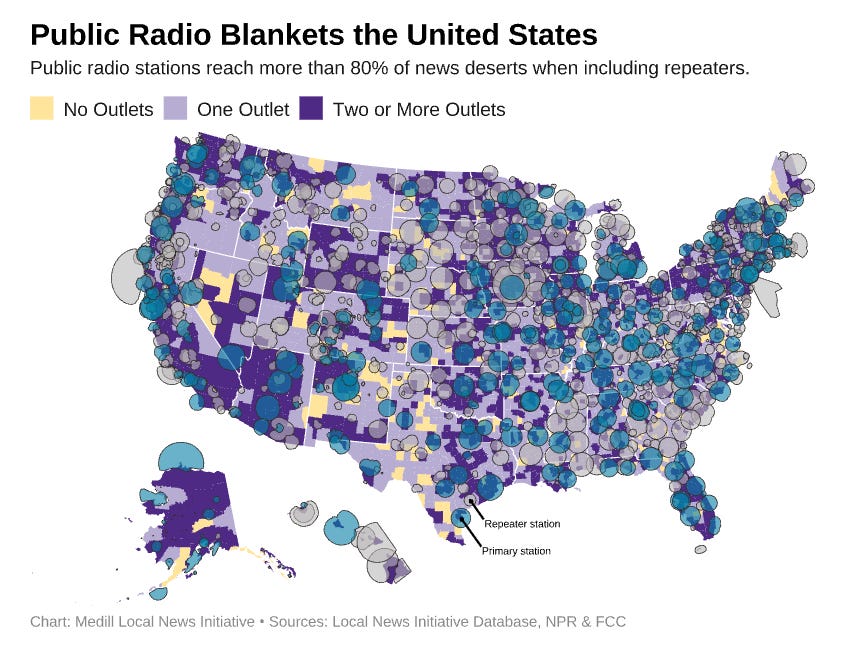
Public broadcast signals reach further into news deserts than most people realize. The 2025 Medill State of Local News report found public broadcasting primary signals cover 46% of news desert counties, jumping to 82% once repeater signals are included. In nine counties — six in Alaska, one in Idaho, one in New Mexico and one in South Dakota — public broadcasting is the only source of local news coverage.
On the commercial side, iHeartMedia operates roughly 860 stations and Audacy owns more than 220. Between those two companies, the commercial cuts are reshaping more than 1,000 stations.
About 50 million Americans live in areas with limited or no access to reliable local news, per the same Medill report. In the places where broadband and cell coverage fall short, radio was reaching a meaningful share of those households before the current cuts began.
🤔 Who Should Care
» Public media leaders working through the CPB aftermath.
» Commercial broadcasters whose local ad base depends on listeners they are driving toward streaming.
» App developers or tool-builders who could assemble shared infrastructure small stations cannot afford on their own.
» Rural county emergency managers, tribal governments, and anyone treating AM radio as the last-mile alert system should also be paying attention.
🏗️ The Structural Root Cause
Network news infrastructure used to do the expensive work for small stations. CBS, ABC, Fox and a handful of others ran White House, Capitol Hill and international bureaus, then piped the reporting out to affiliates for a fee. Small stations never had to staff a Washington correspondent.
The choices shrinking now are both operational and editorial. Mike Haile, a radio personality and former general manager of WDWS in Champaign, Illinois, wrote in the News-Gazette that his station now faces only two realistic replacements for CBS News: ABC Radio or Fox News Radio, and the station is going with Fox. WDWS had been a CBS affiliate for most of its history since 1937, he wrote.
Multiply that editorial calculation across hundreds of newly unaffiliated stations and the center of gravity of American radio news moves. The Writers Guild of America East and West called the shutdown the product of “inept leadership” by CBS News editor-in-chief Bari Weiss and Paramount CEO David Ellison, warning the Ellison family should not be permitted to acquire CNN on top of CBS. Former CBS anchor Dan Rather told the Associated Press it was “another piece of America that is gone.”
Federal public funding was a significant source of support. Congress rescinded the CPB appropriations in July last year, and this January the CPB board voted to dissolve the organization after 58 years rather than continue in a defunded state.
The CPB Impact Report catalogs what the rescission has cost so far:
WPSU at Penn State winding down and ceasing operations entirely by June 30;
KQED in San Francisco reducing its workforce by 67 positions;
GBH in Boston through its second of at least four 2025 rounds of layoffs, having cut 58 staff by July and another 15 in November per the Boston Globe, with American Experience paused;
Kentucky Educational Television eliminating 36 positions, roughly 22% of its workforce;
Wisconsin Public Radio laying off 15 employees and canceling four programs.
The bigger damage is further down the same list.
WQED in Pittsburgh is cutting 35% of its staff. Lakeshore Public Media in Northwest Indiana is reducing two-thirds of its employees to part-time. Basin PBS in West Texas is absorbing a 48% revenue loss. Alaska Public Media has shelved Alaska Insight, its weekly public affairs show. KRZA in Alamosa, Colorado is running programming cuts and layoffs with a real possibility the station shuts down. Those are the stations that cannot absorb this.
Commercial consolidation was another major leg of support, and the hardest to see coming. iHeart and Audacy bought up stations aggressively in the late 2010s and used scale to subsidize local morning shows, midday hosts, news directors and sales teams across their portfolios. That subsidy is ending.
iHeart’s April round hit programming directly, including the six-person Intern John morning show that aired across Washington D.C. and Baltimore. One commenter on Barrett Media’s coverage captured the reaction bluntly: “Ironic that iHeartRadio has lost the ‘heart’ in Radio with all their local and regional layoffs. Instead we’re getting nationally-syndicated Ryan Seacrest who knows (or cares) nothing about local culture.”
Each of these support systems were propping up the other.
A commercial station that loses CBS News has less reason to employ a local news director. A public station that loses CPB cannot afford to maintain the emergency alert equipment that makes its signal valuable to the county. A consolidated station that swaps out its local morning show cannot sell local advertising at the premium it used to command.
Take all those away inside one year and the result is what this edition is documenting: rural America losing the medium that was still reaching it, in real time.
💡 Who’s Solving It (+ How)
The stations most exposed to the cuts are also running the most interesting experiments. None of them scale on their own, but together they sketch what a post-CPB rural radio layer might look like.
✧

KSUT Public Radio in Ignacio, Colorado has already proven the community-fundraising model can work in a tribal and rural market. The station serves the Southern Ute, Ute Mountain Ute, Jicarilla Apache and a large portion of the Navajo Nation, and lost roughly 20% of its $1.5 million annual budget when Congress zeroed out CPB.
Rather than cut, KSUT went to its listeners directly. Development director Chris Aaland told NPR in December that the station had raised more than $500,000 since the rescission vote. Executive Director Tami Graham is using the window that buys to rebuild the station’s longer-term revenue mix. KSUT also joined NPR, Aspen Public Radio and Colorado Public Radio in suing the Trump administration in May last year over an earlier executive order targeting CPB funding.
✧
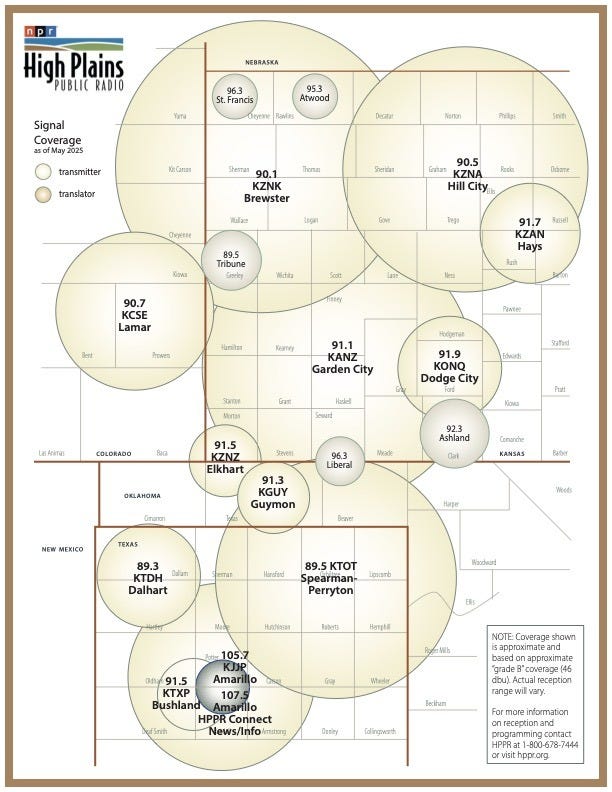
High Plains Public Radio is the clearest example of a rural station treating the CPB cut as an excuse to rebuild bigger. HPPR serves the Oklahoma and Texas panhandles, eastern Colorado, western Kansas and southwest Nebraska — roughly 90 counties across 332 communities.
The day after Congress enacted the rescission in June, HPPR learned it had been awarded a $750,000 three-year Press Forward grant to build the High Plains Civic Media Network, a regional coverage model coordinated by a lean central editorial team and powered by a contributors network of part-time and volunteer community members.
Founder and executive director Quentin Hope is pairing the grant with a local “Up to Us” campaign to raise $550,000 and cover the two-year CPB shortfall. What makes this worth watching is the sequencing. Most rural stations are responding to the cut with defensive moves — cutting programming, cutting staff, waiting for donations. Hope is reframing the same moment as a chance to build something that covers more of the region.
✧
New York Public Radio’s Station-to-Station Programming Project takes the subsidy question in the other direction — from big stations to small ones.
Effective October 1, 2025, NYPR began offering its full WNYC Distribution portfolio for a year — Radiolab, On the Media, The New Yorker Radio Hour, Terrestrials, plus independently produced shows like Science Friday, Freakonomics Radio, and Today, Explained — at no cost to any public radio station receiving 10% or more of its budget from CPB.
That threshold covers roughly 64% of the public radio system. NYPR CEO LaFontaine Oliver told Current the agreements carry a one-year term, so this is just a runway, not a permanent subsidy. It addresses program budgets but not the underlying local reporting gap.
✧

On the policy side, some congressional Republicans are now pushing to restore CPB funding for rural and tribal stations specifically. South Dakota GOP Sen. Mike Rounds brokered a $9.4 million handshake deal with the Trump administration last summer in exchange for his vote on the rescission, routing emergency funding through the Bureau of Indian Affairs to keep tribal and rural radio stations on the air.
Current reported in November that initial award notices have gone out to KILI in Porcupine, South Dakota, KOYA in St. Francis, which serves the Rosebud Reservation, and KDKO in Lake Andes, which serves the Yankton Sioux Reservation. The money covers 38 stations for FY 2026 only.
Rounds is now working with colleagues on the Senate Appropriations subcommittee on Interior and the Committee on Indian Affairs to secure FY 2027 funding. In addition, Alaska Sen. Dan Sullivan and, on the House side, retiring Reps. Mark Amodei of Nevada and Don Bacon, are pushing to restore funding to the Public Telecommunications Facilities Program through the House Appropriations Committee.
Without that extension, most tribal stations could close within 6 to 12 months.
✧
A parallel fight is underway over the hardware itself. The AM Radio for Every Vehicle Act has hit 218 House cosponsors (a simple majority) and 61 filibuster-proof Senate cosponsors, and it is backed by more than 125 organizations including AARP, the National Emergency Management Association, the American Farm Bureau Federation, Native Public Media and SAG-AFTRA. NAB President Curtis LeGeyt said this month the bill is close to floor time.
The AM preservation fight is not a journalism fix. It keeps receivers in vehicles so that whatever local signal survives still has a way to reach a driver in a wildfire evacuation or a tornado warning. Without it, the rural signals still on the air won’t have listeners to reach regardless of what stations rebuild behind them.
🛠️ The Build Opportunity
The three supports being pulled out of American radio are also three pieces of infrastructure somebody now needs to rebuild, priced for stations that can’t carry it alone. Here are four distinct build opportunities worth flagging:
✧
Opportunity 1: A Cooperatively Owned National News Feed
Model it on the old AP Radio, not on a commercial network. Anchor it with public broadcasters, journalism schools, and philanthropic funders. Building the governance and dues structure is the actual work.
✧
Opportunity 2: Cloud-Native Operations for Small Stations
Broadcasting automation was priced for a world where CPB or a consolidator absorbed the overhead. Broadcast Radio’s Myriad Cloud won NAB Show Product of the Year 2024 by running a full professional station on Microsoft Azure with no on-premise engineering. Open-source extensions and shared back-office backends belong next on that stack.
✧
Opportunity 3: Standalone Emergency Alert Infrastructure
When a station goes dark, the local EAS node often goes with it, because the alert runs through the station’s transmitter and engineering staff. FEMA and the National Emergency Management Association have a direct interest in funding redundancy: cooperative alert nodes, satellite backup, or federally leased tower space. That work shouldn’t wait on the next wildfire.
✧
Opportunity 4: Digital Revenue Tools Priced for Small Teams
BIA projects 2026 radio digital revenue at $2.38 billion, up 5%. Small stations can’t capture that upside with tools built for national sales departments. A coop-owned digital sales stack with attribution, CRM, programmatic audio, and first-party data, priced for stations under $5 million in revenue, hasn’t been built yet.
💬 Closing Provocation
“I grew up on the Navajo Nation without running water or electricity, and some parts of the district still do not have broadband or cell service. So, we tribal members heavily rely on the radio to get information.” — Jonathan Nez, former president of the Navajo Nation
⚡️ tl;dr
American radio is collapsing on three fronts inside the same twelve months — CBS News Radio shuts down May 22 after 99 years, the Corporation for Public Broadcasting dissolved itself in January, and iHeart and Audacy are stripping out local hosts and news staff across more than 1,000 stations.
Newspapers took two decades to lose 40% of their footprint; radio is compressing a comparable restructuring into one calendar year, and it’s hitting exactly the rural, tribal, and low-broadband communities newspapers never reached well in the first place.
Every layer of the collapse is also a build opportunity — a cooperatively owned national news feed, cloud-native station software, standalone emergency alert infrastructure, and digital sales tools priced for teams of three — and the stations most hurt by the current collapse are the ones who would opt into any of them on day one.
We're lucky in northern New York to have a superb, guns blazing public radio news operation based out of Canton NY - the local calls are WSLU but collectively (the station runs a fistful of translators) it goes by NCPR. That said, it's not enough. There are little radio stations all around the north country which used to have one and two person news departments but which have been slowly losing ground. One thing your excellent article doesn't mention: those small stations were the first step up the ladder - ie, they were the training ground for stations in small cities, which, in turn, supplied some of large city radio talent.
"A public station that loses CPB cannot afford to maintain the emergency alert equipment that makes its signal valuable to the county."
The EAS device requires virtually no maintenance once it is installed. Stations are further discouraged from performing any maintenance on the devices that would involve turning them off or moving them. As recent FCC enforcement has made clear, even disconnecting the device for one hour requires non-routine advance permission from the FCC.
The sole company still manufacturing EAS devices recently announced a software upgrade. But the upgrade is optional and its features are of no benefit to many stations. I believe thousands of stations are very likely unaware of the upgrade. The manufacturer does not have a practice of contacting customers to offer the upgrade.
"The AM preservation fight is not a journalism fix. It keeps receivers in vehicles so that whatever local signal survives still has a way to reach a driver in a wildfire evacuation or a tornado warning."
There is no evidence that most or even many radio stations, AM or FM, broadcast emergency alerts including evacuations or tornado warnings. Neither FEMA nor FCC collect such evidence. Even the FCC's mandatory EAS Test Reporting System requests no such data from any broadcast station.
The sole required regular EAS activities are the Required Monthly Tests, the National Periodic Test every three years; and the Required Weekly Tests which despite the name are not required to be broadcast.
None of those are broadcast of actual emergency messages to the public, nor does anything require local and state emergency managers to utilize EAS.
While all radio and TV stations are required to broadcast the National Emergency Message (code EAN), no such message has ever been sent.
The National Public Warning System (NPWS) is part of EAS and is based mostly on AM stations, but the NPWS has never been activated.
"When a station goes dark, the local EAS node often goes with it, because the alert runs through the station’s transmitter and engineering staff. FEMA and the National Emergency Management Association have a direct interest in funding redundancy: cooperative alert nodes, satellite backup, or federally leased tower space. That work shouldn’t wait on the next wildfire."
FEMA did fund station upgrades to EAS capability in a series of grants, but the grants went only to PBS and NPR member stations, not commercial stations or LPFM stations. After defunding CPB which was FEMA's contractor for issuing the grants, the second Trump administration made broadcast stations ineligible to apply for the funds.