

This newsletter is free and will stay free. If it’s useful to you, a paid subscription is the best way to keep it going. —Luis G.

When The Washington Post killed its flagship daily podcast and more than a third of its newsroom this February, it confirmed what publishers across the industry already know; that print still pays the reporters, but the audience that might fund journalism into the 2030s doesn’t necessarily want a printed paper.
The idea for this edition came from Mark Lyndersay, editor of the technology news publication TechNewsTT and a reader of this newsletter. He framed the question by asking how news publishers can make the leap to the new audience while holding onto the last remaining revenue streams of the old one.
So far, no major U.S. publisher has answered that question with full clarity yet. The cost of trying to be both products at once, of running the old model and the new one on the same budget, creates a financial strain that proves fatal for some news organizations.
This is what happens when a publisher can’t decide what it is, and which audience to serve. And the Post isn’t the only one.
The Pain Point
Running a print edition requires presses, distribution trucks, and a production workflow built for a daily deadline cycle. Building for under-35 audiences requires video teams, podcast producers, social-first editors, and newsletter operations that look nothing like a traditional news desk.
TV and radio newsrooms face their own version of the same bind, between linear broadcast and on-demand digital, but the revenue math hits legacy newspapers hardest and earliest.
A newsroom trying to fund both ends up under-resourcing each, and the compounding cost shows up in the newsroom budget, the subscriber base, and the product itself.
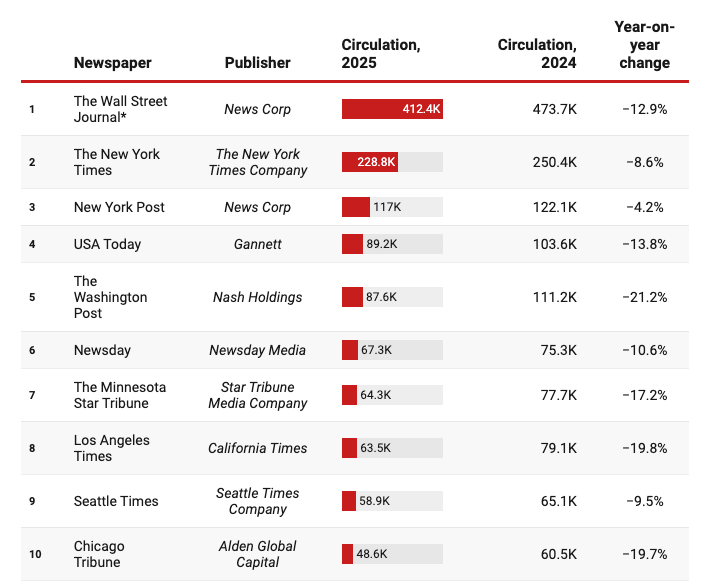
Print still pays the reporters. Roughly 58% of U.S. newspaper revenue still comes from print, and at many regional outlets the share runs higher. But the print subscriber base is shrinking. Combined daily print circulation at the 25 largest U.S. newspapers fell 12.5% in the year ending September 2025, with The Washington Post down 21.2% alone. That’s the revenue base funding the entire operation contracting by double digits, year over year.
Digital is where the next generation of readers actually lives. Reuters Institute’s 2025 Digital News Report found that 54% of U.S. 18–24-year-olds and 50% of 25–34-year-olds now name social or video networks as their main source for news, with the 18–24 figure up 13 percentage points year over year. Global social video news consumption rose from 52% in 2020 to 65% in 2025.
Meanwhile, Medill’s State of Local News 2025 found that web traffic to the top 100 U.S. newspapers has dropped more than 45% since 2019, as Google’s AI Overviews and platform-side changes hollow out the referral traffic publishers spent two decades building strategies around.
Most outlets can afford to do one of those things well. Committing to print means a disciplined, premium product for an aging subscriber base, but one that pays more per head. Committing to digital means underwriting the formats that actually reach under-35 audiences: vertical video, hosted podcasts, creator-style newsletters, and the staffing to produce them at a pace platforms reward. Either path is expensive, and each demands its own organizational calculus.
Trying to fund a newsroom with both audiences at once, in my opinion, is creating tension for an already fragile infrastructure.
And it is visible in the financials. The Washington Post reported $277 million in losses over three years. And then there’s Gannett’s simultaneous decline in both print and digital-only subscription revenue in Q3 2025. The Los Angeles Times subscriber base is bleeding out as billionaire owner Patrick Soon-Shiong rearranges its editorial identity without a clear audience in mind; it is down roughly 25,000 subscribers since September 2024, on top of a $50 million loss for the year.
It’s also visible in the product — in daily podcasts canceled the same week a foreign desk gets gutted and in opinion sections retooled for audiences the newsroom isn’t actually reaching. The compounding cost is that each year of indecision raises the price of the decision still to come.
Pain Point Score: High
The pain is mostly felt at regional and metro dailies. These outlets carry the full cost of a print operation, presses, trucks, delivery routes, production staff, without the national subscriber base or diversified product suite to absorb the loss.
When the Los Angeles Times loses 25,000 subscribers, it’s a crisis. When Hudson County’s Jersey Journal ended its 157-year run in February 2025, its parent company shut down the printing plant, and the paper concluded a digital-only model couldn’t sustain its journalism. And that’s what the endgame looks like. Regional and metro outlets feel the cost first, and they feel it hardest.
Why It Matters
Print still accounts for roughly 58% of U.S. newspaper revenue, according to Grand View Research’s 2024 market analysis. But the Reuters Institute’s 2025 Digital News Report found that 44% of 18–24-year-olds globally — and a majority of the same age group in the United States — say social or video platforms are their main news source.
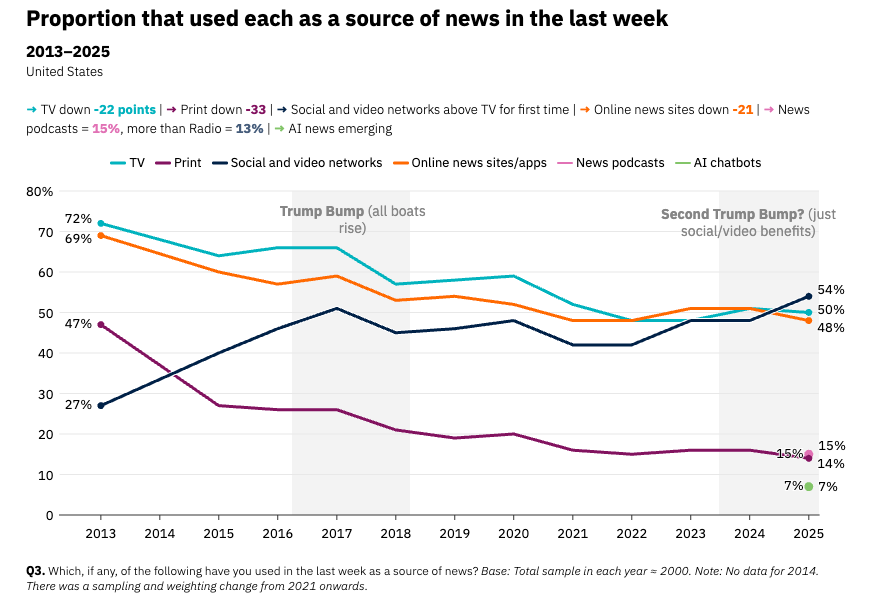
The shift isn’t limited to younger readers: across all U.S. adults, social and video platforms now reach more people for news (54%) than TV (50%) or news websites (48%).
The revenue and the audience aren’t in the same place. Spending to reach under-35s doesn’t generate the revenue print still produces, and spending on print doesn’t reach the audience the next decade depends on.
Medill’s State of Local News 2025 report puts the scale of the retreat in context: 136 newspaper closures in the past year, web traffic to the top 100 U.S. newspapers down more than 45% since 2021, and 50 million Americans now living in counties with limited or no access to local news.
Who Should Care
» Newsroom leaders at regional and metro dailies who pay attention to their financial statements. If you’re losing print subscribers faster than digital subs can replace them, and you can’t name the one audience your product is built for, you are caught in this rift.
» Independent journalists and creators who reach audiences on YouTube, Substack, and podcast platforms. This is precisely the audience metro dailies can’t figure out how to serve. Your pitch to readers is also a pitch to newsroom partners.
» App developers and product leaders who see the tooling gap around audience migration, bundle management, and nonprofit conversion as an opportunity. More on this below.
The Structural Root Cause
Newsrooms face many headwinds in today’s digital landscape, and audience dilemmas are multifaceted that require their own treatment; because in reality there are several audience challenges that the industry as a whole hasn’t quite settled on.
Christian A. Hendricks, the publisher and founder of the Holly Springs Update in North Carolina, recently touched on one of these audience challenges for E&P Magazine.
In his piece, Hendricks argues that newsrooms trying to balance reach and depth face a structural failure mode. The faster, easier work expands over time while resource-intensive reporting loses ground — not because of discipline failures, but because systems that measure success broadly naturally reward what’s quickest to produce.
“If the objective is reach, then volume, speed and breadth are logical priorities. If the objective is to inform a community in a meaningful way, the model necessarily looks different. It emphasizes specificity over scale, depth over frequency and consistency over cadence,” Hendricks said.
Reach and depth aside, the audience problem sits on top of an old engine that powered the whole operation.
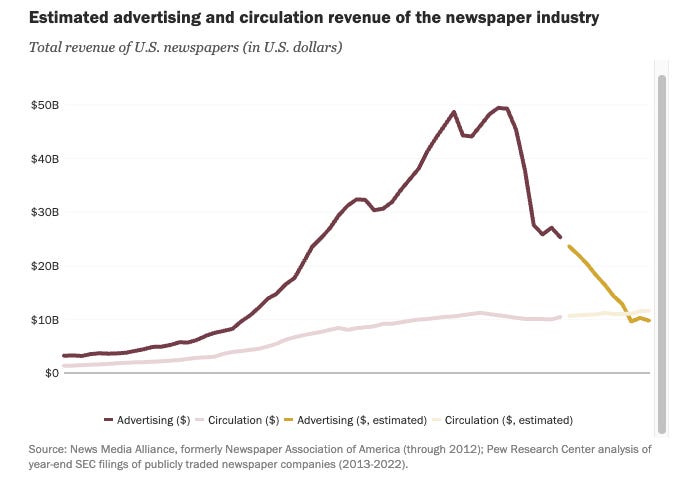
Print advertising paid for most of the 20th-century newsroom, and that revenue has collapsed. Total advertising revenue at publicly traded U.S. newspaper companies fell from roughly $23 billion in 2013 to about $9.8 billion in 2022, less than a fifth of its 2006 peak. The digital advertising that was supposed to replace it went to Google and Meta. Subscription revenue at most outlets hasn’t closed the gap.
That’s the survival pressure, and it lands on a demographic split. Only 4% of U.S. print newspaper readers are under 35; 46% are 55 or older. The audiences replacing them are watching news on social and video, without having to pay for it.
Newsrooms are now reorganizing their finances and staffing around an audience that hasn’t yet replaced the revenue the older audience generated. The cuts and rebrands at major U.S. outlets all follow that pattern.
The Washington Post lost an estimated $277 million over three years and laid off roughly 300 of 800 newsroom journalists in February 2026. It killed sports, books, and foreign bureaus along with “Post Reports,” its under-35 daily podcast. The Post’s average daily print circulation fell 21.2% to 87,576 in the year ending September 2025 — the steepest decline among the top 25 U.S. newspapers.
The Los Angeles Times is bundling the paper with creator, gaming, and studios operations under a new “L.A. Times Next Network” entity it plans to take public. The strategy depends on attracting new audiences. Meanwhile, owner Patrick Soon-Shiong has alienated the paper’s existing California readership by blocking its 2024 Kamala Harris endorsement, which prompted roughly 18,000 immediate subscription cancellations, and by reshaping the editorial board with conservative voices.
Gannett renamed itself USA TODAY Co. on November 18, 2025 even as its digital-only subscription revenue, the line supposed to replace print, fell 13% year-over-year in Q3.
All three news organizations are restructuring toward an audience that hasn’t paid for accountability journalism at the scale the old audience did, while cutting the operations that audience funds.
When Hendricks tries to answer the question whether newsrooms should serve what audiences want vs what they need, he reframes it by asking whether a single newsroom model can serve two fundamentally different objectives at once; and his answer is no.
The cost Hendricks names most directly is strategic, not financial. He says you have to be willing to define your purpose clearly enough to let it cut things out. Newsrooms that won’t make that call don’t avoid the cost — they just pay it slowly, in eroding relevance.
Who’s Solving It (and How)
No one has solved the financial aspect of the audience dilemma just yet. What exists instead are bets — each one a different theory of which trade-off is worth making.
Three of them are worth examining. One metro daily went all-digital and shed print entirely. One national outlet built a bundle large enough to make the math work. One nonprofit moved a struggling paper out of private ownership and reset the equation. None of these is a template. Each carries its own costs.
✧

The Atlanta Journal-Constitution ended its print run on December 31, 2025, with roughly 115,000 paid subscribers at the time — 75,000 digital-only, 40,000 still on print — and a stated goal of 500,000 digital subscribers. The outlet is offering an ePaper replica for readers who want the newspaper layout, and launched an updated mobile app.
Publisher Andrew Morse said the shift would let the organization put all its resources into digital journalism. In practice, the AJC laid off 50 staffers — about half from the newsroom — within five weeks of going digital.
✧
The New York Times added 450,000 digital-only subscribers in Q4 2025, with digital advertising revenue up roughly 25% year-over-year. The Times bundles news with Games, Cooking, and other products — meaning those products help carry the cost of the newsroom rather than sit alongside it as separate bets. That model depends on a subscriber base in the tens of millions. Metro dailies don’t have it, which is why this isn’t transferable.
✧

This month, the Venetoulis Institute — the nonprofit parent of The Baltimore Banner — signed an agreement to acquire the Pittsburgh Post-Gazette. Block Communications had lost more than $350 million running the Post-Gazette over two decades before announcing its January 2026 closure.
The approach: move the paper out of private ownership, reduce costs, and open the door to philanthropy. Venetoulis chairman and founder Stewart Bainum has signaled the Post-Gazette’s newsroom of 100 will likely shrink. For metro dailies that can’t reach Times scale or go all-digital, this is the model getting the most serious attention right now.
The Build Opportunity
These transitions are expensive, manual, and easy to get wrong. Most publishers are navigating them without dedicated tooling — making gut calls in boardrooms, rebuilding legal and operational infrastructure from scratch, or watching archives disappear when a paper closes. Four gaps worth building into:
✧
Opportunity 1: A Commitment-Decision Tool for Newsroom Leaders
Publishers deciding whether to drop print are mostly working from instinct. A tool that combines subscriber cohort data, print distribution costs, digital ARPU trends, and regional demographic projections — and outputs a clear, outlet-specific answer about when print stops paying for itself — would replace the boardroom gut call with something defensible. The inputs exist. Nobody has packaged them for this decision.
✧
Opportunity 2: Nonprofit-Conversion Infrastructure
The Venetoulis model works because Stewart Bainum had $50 million and a willingness to spend it. Most family-owned dailies don’t have that runway or those connections. A playbook-plus-tooling product covering legal templates, donor pipeline management, subscriber migration workflows, and board governance modules would let a regional paper execute a Banner-style conversion without rebuilding every system from zero.
✧
Opportunity 3: Bundle Management for Regional Outlets
The Times runs five products on one login because it has an engineering team to build and maintain that infrastructure. A hosted, lightweight version of that for regional outlets — covering newsletter bundles, podcast paywalls, event registration, and churn modeling — would let a mid-sized daily test product diversification without hiring a platform team to support it.
✧
Opportunity 4: Closure and Preservation Tooling
Of the 136 newspapers that closed last year, most were small family-owned weeklies with decades of archives that had no place to go. Archive preservation tools, subscriber-transfer workflows, and handoff templates would let a shuttering paper pass its readers and records to a nonprofit or regional outlet instead of disappearing. Right now there is no standard process for that handoff. And I believe there should be one.
Closing Provocation
“That is how information begins to move through a community. It builds understanding first and, over time, trust. Not the kind of trust that comes from a single story or a spike in attention, but the kind that develops when information is repeated, discussed and confirmed in real-world experience. When what people read aligns with what they see and hear, and when it proves useful repeatedly, confidence in the source grows.” — Christian A. Hendricks, publisher and founder of the Holly Springs Update in North Carolina
Wow! You've nailed it! The hat-tip is appreciated!
Mark is a friend and colleague and his writing has been on point with this.