


Across America, more kids are playing organized sports than ever before. Almost no one is covering them.
Local newsrooms have hollowed out their sports desks, leaving millions of families, athletes, and communities with no one telling their stories. It’s not a small gap — it’s enormous. And it represents the biggest unclaimed business opportunity in American media.
A new report analyzing 559 funding proposals for local journalism confirms the underlying cause: the threats to local news aren’t individual newsroom failures; they’re ecosystem-level infrastructure breakdowns.
But while funders and policymakers debate the diagnosis, some of the sharpest business minds in media are already placing their bets — not on city hall coverage or investigative units, but on Friday night football.
(Click to skip to the tl;dr summary of this newsletter.)
🩺 The Pain Point
The U.S. just recorded its highest-ever high school sports participation, and yet the journalism ecosystem that once covered those games has all but collapsed.
The NFHS 2024–25 High School Athletics Participation Survey confirms that participation has surged by more than 645,000 athletes in just three years, with breakout growth in girls’ flag football (up 60%), and girls’ wrestling (up 15%).
More than 3,200 newspapers have closed since 2005. News desert counties have hit a record 213, and roughly 50 million Americans now live with limited or no access to local news.

The reporters who once filed Friday night game recaps, profiled breakout athletes, and held athletic departments accountable are largely gone. What remains is a structural mismatch: demand for school sports content is surging while the professional supply has cratered.
High school sports coverage once served as community connective tissue that bound neighborhoods through shared stories the way obituaries and school board reports did. When that coverage disappears, something civic disappears with it.
🟡 Pain Point Score: RISING
The collapse of local school sports coverage is a structural market failure with proven revenue implications. In the meantime, competitors (social creators, school-produced content) are filling the vacuum with no editorial standards.
The social media replacements are not communal in the same way. They are siloed experiences — you learn about your friends’ feeds, not a stranger’s story.
There is a difference between a highlight clip going viral and a beat reporter writing about the sophomore who broke the school’s 800-meter record in front of 200 people on a Tuesday afternoon. The first entertains. The second witnesses.
The coverage gap is a market failure with civic consequences, one that is deepening as participation rises and newsrooms continue to shrink.
📊 Why It Matters
The numbers make the business case impossible to ignore.
In August 2025, the Minnesota Star Tribune launched Strib Varsity, a dedicated high school sports product. Within months, it accounted for 10% of new subscriptions, with its paywall converting readers at roughly 3x the rate of the paper’s main site.

MassLive, a digital outlet under Advance Local, reported that about a third of its new subscriptions came through high school sports content. And the Boston Globe launched in 2025 a dedicated high school sports team and initiative citing growing interest from families and athletes.
These aren’t anomalies — they’re proof points. The Local News Initiative’s profile of these efforts documented how high school sports is emerging as one of the most reliable subscription engines in local media.
While web traffic to the 100 largest newspaper sites has plummeted more than 45% in four years, local school sports coverage is making the search for differentiated, high-engagement content existential.
MassLive’s VP of Content Ronnie Ramos called it content readers can’t get anywhere else and noted that people will pay for it.
🤔 Who Should Care
» Newsroom leaders and publishers: You’re leaving the most proven subscription driver on the table. The Star Tribune and MassLive have demonstrated the model. The question is: why haven’t you replicated it?
» Developers and product builders: The tooling for local sports coverage — stats engines, live-streaming infrastructure, community engagement platforms — is woefully underdeveloped. This is greenfield territory.
» Independent journalists and creators: Social-native creators are already filling this vacuum with mic’d-up footage and highlight reels. But they lack the editorial standards and investigative capacity that professional journalism brings. There’s a hybrid model waiting to be built.
» Philanthropic funders and investors: A new report by Elizabeth Hansen Shapiro, analyzing 559 Press Forward infrastructure proposals, argues that the era of individual newsroom experimentation is over. The field needs system-level investments that lower the cost of producing local journalism. Sports-driven local models are exactly the kind of scalable infrastructure play the report calls for.
🏗️ The Structural Root Cause
The diagnosis here runs deeper than “newspapers are closing.” I can identify at least three compounding forces have created this gap:
First, the economic collapse of local news hit sports desks early and hard. Sports coverage was often the first casualty of shrinking newsrooms because it was seen as discretionary, the proverbial “toy department,” despite growing evidence it’s among the most effective content for driving subscriptions.
Let’s not forget that The Washington Post eliminated its entire sports section in February this year. This move alone signaled the latest and most dramatic blow to sports journalism, which has seen reporters cut or reassigned across the industry.
Second, national platforms cannot fill the local gap. When The New York Times purchased The Athletic for $550 million, it put the Times in “direct competition with every local news site” for subscribers.

But The Athletic covers roughly 270 professional and major college teams. It does not, and structurally cannot, cover 20,000 high schools producing 8.2 million athletes. No national platform has the incentive or capacity to do this.
Third, the funding ecosystem rewards experimentation over scale. Hansen Shapiro’s new report is blunt on this point: philanthropy tends to be time-bound and project-based, which produces fragmented, newsroom-by-newsroom solutions that never reach the scale needed to address a systemic problem.
As she told ProPublica founding general manager Richard Tofel in a Nieman Lab interview: the era of innovation is over. What’s needed now are scaling solutions, and funders willing to pick winners and let failing experiments die.
💡 Who’s Solving It (+ How)
From the Star Tribune’s paywall-busting prep sports product to Chuck Todd’s proposed $2 billion franchise network, a growing number of publishers are treating high school sports not as a soft feature, but rather as a business model.
The through line: content readers can’t get anywhere else, serving communities willing to pay for it. Here are four compelling models worth watching.
✧
Star Tribune / Strib Varsity (Minneapolis). The most ambitious model currently operating. Strib Varsity combines dedicated sports journalism with a stats-and-scores engine and live-streaming for hundreds of Minnesota high schools.
The product has its own paywall tier and is converting readers to paid subscribers at three times the rate of the main site. This is a high-investment play, but it’s proving the model at scale.
✧
MassLive (Massachusetts) offers a leaner approach under Advance Local. MassLive currently covers 95 teams statewide and is expanding into the Boston and Worcester areas. VP of Content Ronnie Ramos said he has plans for live-streaming and a high school version of NFL RedZone — weekly video highlights across games.
✧
Chuck Todd’s proposed micro-outlet network. The former Meet the Press moderator has made local youth sports the centerpiece of a proposed $2 billion media venture. His model: a franchise-style network of up to 1,000 community-owned sites where sports-driven advertising revenue subsidizes broader local journalism.
Todd told LNI that the first three hires at any new local news organization should be a lead high school sports reporter, a micro weather forecaster, and a consumer/food reporter. He frames sports as the most sustainable revenue stream for local news — not a soft feature.
✧
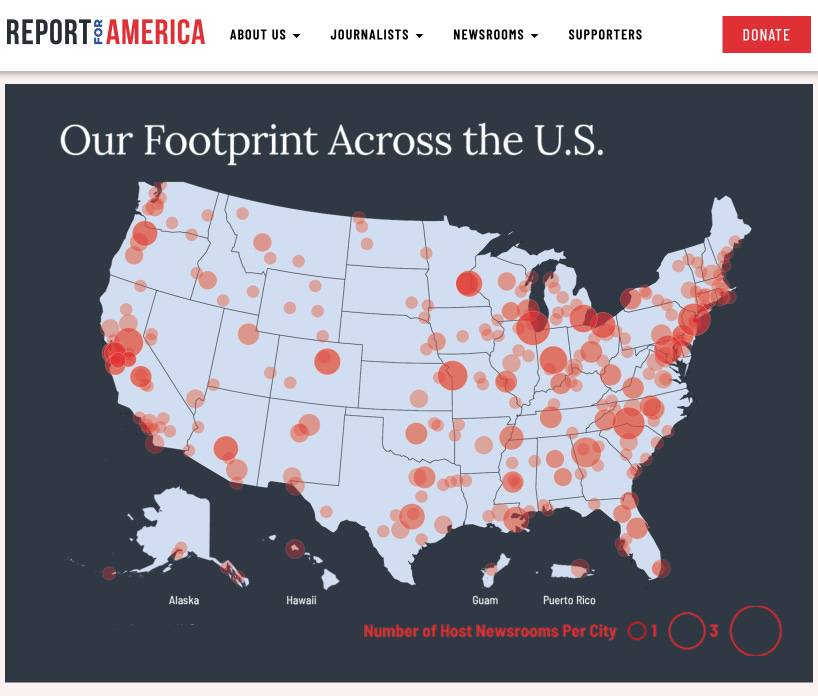
Report for America launches its first sports corps. The national service program launched in 2017 by The GroundTruth Project places emerging journalists in local newsrooms to cover under-reported communities and beats. To date, RFA has partnered with more than 400 newsrooms across all 50 states, and by mid-2026 will have more than 200 active corps members in the field.
For its first eight years, the program focused almost entirely on civic accountability beats like government, criminal justice, health, immigration, education. It wasn’t until this year that RFA launched its first-ever sports corps — with just five positions nationwide, including one dedicated to high school and youth sports in Arizona.
🔧 The Build Opportunity
The tooling layer for local school sports coverage barely exists. This is where developers and product builders should be paying attention. What’s needed isn’t another one-off experiment. It’s shared infrastructure that any newsroom can plug into and go live in weeks, not years.
The Strib Varsity model proves there’s demand. The Hansen Shapiro report proves the field needs a platform layer, not more pilots. Think of it as Substack meets ESPN+ meets a local stats engine, purpose-built for high school markets.
✧
Opportunity 1: A sports-local-news operating system
No single product currently combines real-time stats ingestion, low-cost live-streaming, community engagement tools, subscription infrastructure, and AI-assisted content generation for high school sports at scale.
Most stats are still tracked on paper or in disconnected coaching apps. Most live-streaming still assumes a broadcast truck. The opportunity is an integrated platform layer that legacy papers, digital startups, and micro-outlets alike can deploy without building from scratch.
✧
Opportunity 2: AI-augmented coverage that scales without replacing journalists
Patch’s AI-driven newsletter system has already demonstrated that AI can extend hyperlocal reach to 14,000 communities and nearly a million subscribers.
Imagine that same scaling logic applied specifically to school sports — automated game recaps, statistical analysis, and event scheduling that augment human reporting rather than replace it, with editorial standards and community trust baked in from the start.
✧
Opportunity 3: Community engagement infrastructure for hyperlocal audiences
The missing piece isn’t just content — it’s connection. Parents, coaches, and athletes currently have no unified way to interact around local sports coverage.
The build opportunity includes subscription and paywall tooling optimized for hyperlocal audiences, notification systems tied to specific teams and athletes, and feedback loops that make the audience part of the coverage.
This is what turns a reader into a subscriber and a subscriber into a recurring revenue source.
💬 Closing Provocation
“The first three hires I would make starting a local news organization would be a lead high school sports reporter, a micro weather forecaster, and a consumer/food reporter. Too many local news startups start with trying to get the news junkies to pay for subscriptions. I think you’re a closed audience there. Start with the widest possible pool.” — Chuck Todd, in conversation with Medill’s Local News Initiative
⚡️ tl;dr
High school sports participation just hit a record high, but the local journalists who used to cover those games are mostly gone. More than 3,200 newspapers have closed since 2005, and sports desks were often cut first. The result: a massive gap between surging demand and vanishing coverage.
But a few players are proving this gap is also a business opportunity. The Star Tribune’s prep sports product converts subscribers at 3x its normal rate. MassLive is seeing a third of new subscriptions come through high school sports. Chuck Todd wants to build a $2 billion franchise network with sports as the revenue engine. And Report for America just launched its first-ever sports corps after eight years of ignoring the beat.
The newsletter argues this isn’t just a content play — it’s an infrastructure problem. What’s missing is shared tooling (stats engines, live-streaming, community engagement platforms) that any newsroom could plug into, rather than each outlet building from scratch. The closing message: stop treating school sports as a soft feature — it may be the most sustainable path to local news revenue.