


The number that newsrooms have worshipped for two decades — web traffic — is now lying to them.
The industry spent years optimizing for a metric controlled entirely by Google and Facebook, and now that those platforms have changed the rules, publishers are discovering they never actually knew their audiences at all.
The collapse isn’t coming. It already happened. But here’s what most coverage of this crisis misses: the publishers who stopped worshipping traffic years ago aren’t just surviving. They’re growing.
(Click to skip to the tl;dr summary of this newsletter.)
🩺 The Pain Point
For years, web traffic was the universal metric of digital news. It’s what publishers showed advertisers, what funders used to justify grants, and what boards cited to measure impact. The entire business infrastructure of online journalism was built on the assumption that Google and Facebook would keep sending people to news websites.
That assumption has been shattered. A March 2026 analysis by Growtika found that 10 major tech publications — CNET, Wired, The Verge, TechRadar, and others — lost a combined 65 million monthly organic visits from Google since their 2024 peaks. That’s a 58% decline!
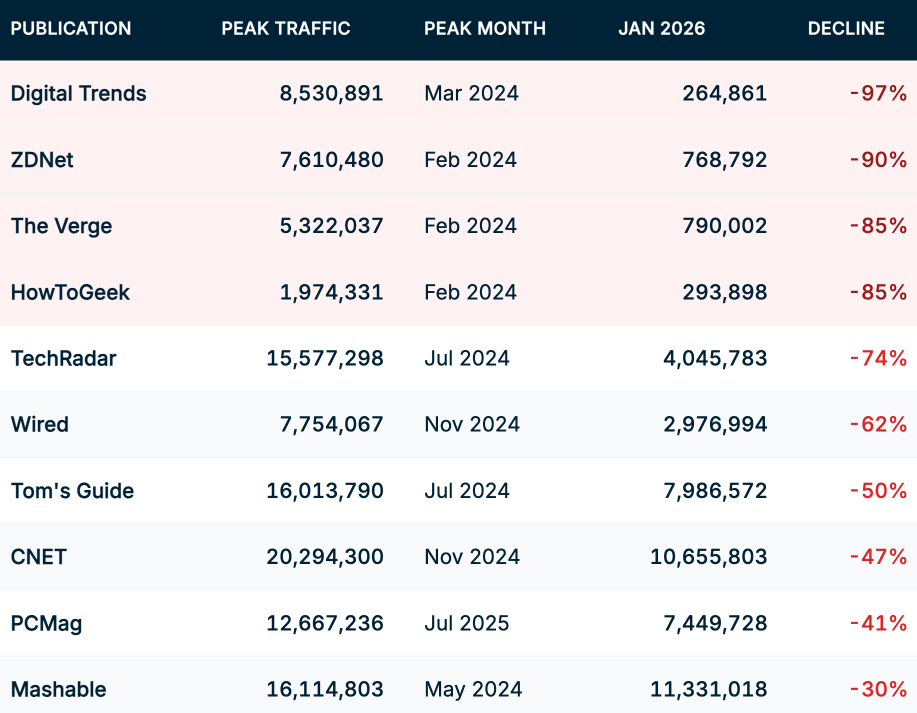
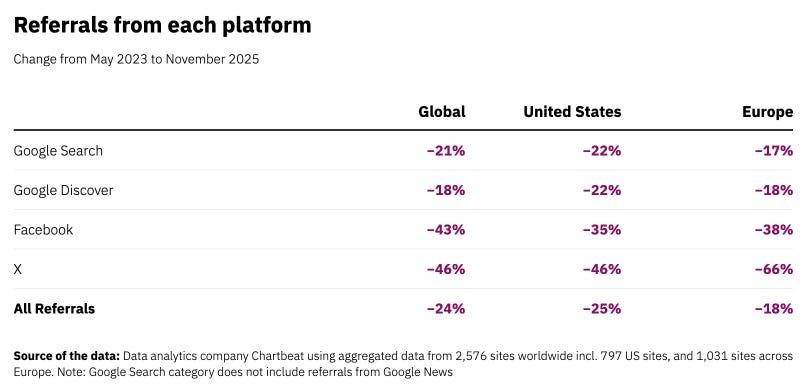
Some individual sites fared far worse: Digital Trends fell 97%, ZDNet dropped 90%, and The Verge lost 85% of its search traffic. Meanwhile, the Reuters Institute’s 2026 Trends report found that Facebook referrals to news sites have dropped 43% in the last two and a half years, with X (formerly Twitter) referrals falling 46%.
But the pain has not been evenly distributed. Chartbeat data drawn from over 2,500 publisher websites, cited in the Reuters Institute report, shows that publishers specializing in lifestyle or utility content — weather, TV guides, horoscopes — were more likely to have been affected by the decline.
The traffic isn’t shifting to another platform that publishers can chase. It’s disappearing into AI-generated answers, walled-garden social feeds, and direct conversations with chatbots. The scoreboard that newsrooms have been reading is broken, and most still don’t have a replacement.
🔴 Pain Point Score: HIGH
This is a high urgency problem, but not for the reason most people assume. The crisis is not that traffic decline automatically means revenue decline, but the publishers proving that are a specific kind of publisher.
Digiday’s analysis of subscription trends, drawing on its 2025 Subscription Index and other public earnings data, found that The New York Times accelerated digital subscription growth by 6.5 percentage points between 2023 and 2025, with average revenue per user rising year-over-year to $9.72. The Guardian posted an 8.2-point jump in subscription growth acceleration. Bloomberg raised its annual subscription price 33% year-over-year.
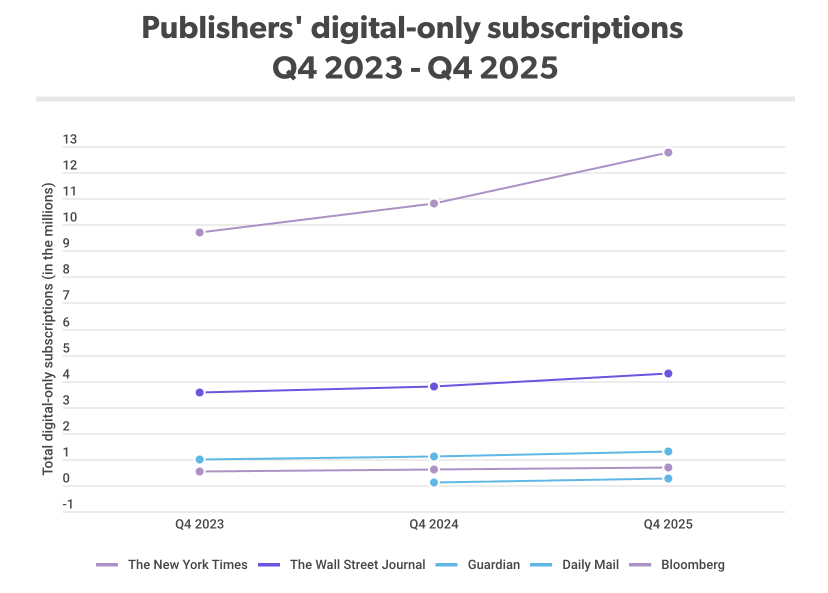
But these are elite, well-resourced publishers with strong brands and large audiences. The majority of newsrooms have not made the same transition, and many lack the capital or reach to try.
A Local Media Consortium survey of executives across 170 local media companies found a dramatic increase in the number of publishers identifying subscriber retention as a top challenge. Most of the closures aren’t happening at outlets that failed to diversify — they’re happening at small, independent publishers that never had the resources to begin.
And even for publishers who have built subscription models, the traffic collapse isn’t neutral. Digiday reports that audiences arriving through search convert to paid subscriptions at roughly 3x the rate of those arriving through Google Discover. Losing search traffic doesn’t just hurt ad revenue; it also shrinks the subscription funnel.
The gap between publishers who built direct audience relationships and those still renting them from platforms is widening fast. Traffic’s collapse is making the divide impossible to ignore, and for the publishers on the wrong side of it, every month spent measuring success by a collapsing metric is a month closer to joining the growing list of closures.
📊 Why It Matters
The numbers tell two stories at once: one of collapse, and one of adaptation.
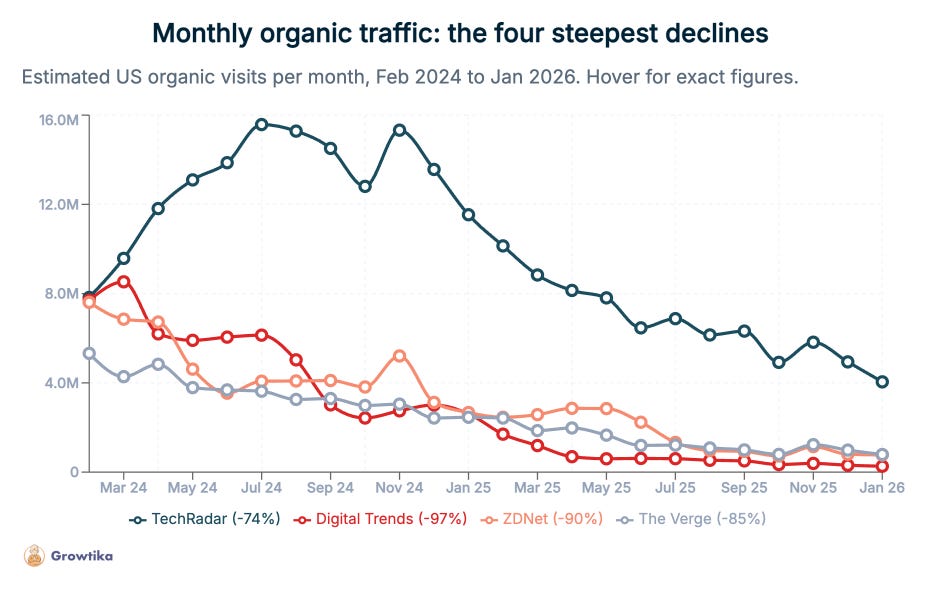
On the collapse side, the data is stark. The Growtika analysis found that 4 of the 10 publications studied now generate less combined traffic (2.1 million visits) than the r/ChatGPT subreddit alone (4.68 million). TechRadar’s traffic loss of 11.5 million visits exceeds the current total traffic of Wired, The Verge, ZDNet, HowToGeek, and Digital Trends combined. And it’s not just tech media. Healthline lost 55 million monthly visits. NerdWallet, a publicly traded company, saw a 73% decline.
However, Piano.io’s 2026 publisher data shows that even as median traffic fell 2%, revenue climbed 10% — and 70% of publishers who saw traffic decline still grew revenue. Highly engaged users generate 110 times more revenue than one-off visitors — $25.52 versus $0.23 per thousand visitors. One could reach the conclusion that traffic volume has decoupled from both audience value and revenue potential.
The publishers who recognized this early are now pulling ahead.
The Reuters Institute’s 2026 Trends report found that 76% of publishers now rank subscriptions and memberships as their top revenue focus for 2026, ahead of display advertising (68%) and native advertising (64%).
On Substack, more than 5 million paid subscriptions are now active across 35 million total subscriptions. The top 10 publications collectively earn more than $40 million per year, and 52 individual publications earn at least $500,000 each.
Beehiiv’s 2026 State of Newsletters report found that paid subscriptions on its platform generated $19 million in 2025 versus $8 million in 2024 — a 138% jump! New newsletter creators reached their first dollar in a median of just 66 days.
🤔 Who Should Care
» Newsroom leaders and editors-in-chief who still use traffic dashboards to evaluate editorial success and make staffing decisions. If your strategy meeting starts with a pageview report, you’re optimizing for a broken scoreboard.
» Revenue and advertising teams who pitch traffic numbers to advertisers and are watching CPMs (cost per thousand impressions) erode alongside visits. The pitch needs to shift from volume to attention and engagement — and the data to support that shift now exists.
» Audience development and growth teams who need new KPIs to justify their strategies and budgets. The most useful growth metrics in 2026 are registration rates, return frequency, newsletter subscriber depth, and cross-platform engagement; not unique visitors.
» News technology developers and product teams building the next generation of analytics and distribution tools. The infrastructure opportunity here is enormous.
» Funders, donors, and board members who have used traffic as a proxy for impact without questioning what it actually measured. The Knight Foundation and the American Journalism Project are already investing in audience development and revenue diversification as the new markers of newsroom health. Other funders should follow.
» Independent journalists and creator-journalists who are building media businesses on platforms like Substack, YouTube, and Patreon. The traffic collapse is your competitive advantage — your direct audience relationship is the asset legacy newsrooms are scrambling to build.
🏗️ The Structural Root Cause
The diagnosis here is dependency masquerading as strategy, and it runs deeper than measurement.
For two decades, news publishers treated Google and Facebook as permanent infrastructure. They optimized headlines for search algorithms, designed stories around trending queries, and structured entire beats around what would perform in the feed. Newsrooms didn’t build audience relationships. They rented them from platforms.
When those platforms pulled back from news, Facebook pageview referrals in the U.S. dropped 35% while those from X fell 46% from 2023 to 2025, and thus the dependency was exposed.
This created a dangerous blind spot. Publishers could tell you how many people clicked on a story, but not why those people came, whether they valued what they read, or whether they’d come back. Traffic measured distribution efficiency, not audience connection.
Piano.io’s publisher data illustrates the cost of that blind spot: one-off visitors make up 60% of traffic but generate almost no revenue, while highly engaged users convert at 44 times the rate. And yet most publishers optimized for the former, not the latter.
When Google introduced AI Overviews that answer queries directly in search results, the publications most dependent on “how-to” and “best of” queries — exactly the kind of commodity content that platforms can now generate themselves — saw the steepest declines, Growtika’s analysis found.
But the structural failure goes beyond choosing the wrong metric. Publishers also outsourced their entire distribution infrastructure to search engines and social media platforms. The measurement problem and the distribution problem are entangled but distinct. Fixing how you measure success won’t help if you still have no independent way to reach your audience.
As if things weren’t unstable enough, an even deeper structural shift is emerging. According to the 2025 Imperva Bad Bot Report, automated traffic surpassed human-generated web traffic for the first time in a decade, accounting for 51% of all web activity in 2024. The surge is largely driven by AI and large language models, which have made it easier than ever to create and scale bots that crawl, summarize, and transact on behalf of humans.
And the trend is accelerating. AI bot visits to publisher sites grew by roughly 400% over the course of 2025 alone, according to TollBit’s quarterly tracking data. The web is quickly becoming a place built for machines first and people second. And now publishers must contend not just with fewer human visitors but with a fundamental change in what a “visit” even means.
As the Newzdash 2026 News SEO report put it: winning in 2026 is about owning topics, not just ranking URLs. The report’s panel of 20 global experts highlighted the need to move beyond pageviews toward engagement, return rate, and value-based metrics.
That shift is underway at some publishers. But for most newsrooms, the tools, frameworks, and internal culture to measure what “owning a topic” actually looks like remain a work in progress — to say nothing of the distribution channels needed to reach people directly when they do.
💡 Who’s Solving It (+ How)
The response to the traffic collapse is emerging on mainly two fronts: direct-to-audience distribution and measurement innovation. No single solution has become the new standard, but the pieces of a post-traffic ecosystem are taking shape.
✧
Direct-to-Audience Distribution
Newsletters can be thought of as owned infrastructure. Email has emerged as one of the most resilient distribution channels in journalism. Unlike social feeds or search results, newsletters are permission-based, algorithm-resistant, and owned by the publisher.
Substack now hosts more than 50,000 publications earning money, with open rates that often exceed 40% — dwarfing typical web engagement metrics. On beehiiv, paid subscriptions grew 138% year-over-year and the platform powered 28 billion emails in 2025. Paved’s network now reaches 253 million newsletter subscribers across 3,000+ publishers, demonstrating that newsletter advertising has matured into a standalone revenue channel.
Another example of owned distribution is YouTube — the new front page. YouTube became the highest-priority platform for news publishers in 2026, scoring +74 net in the Reuters survey, up from +52 last year.
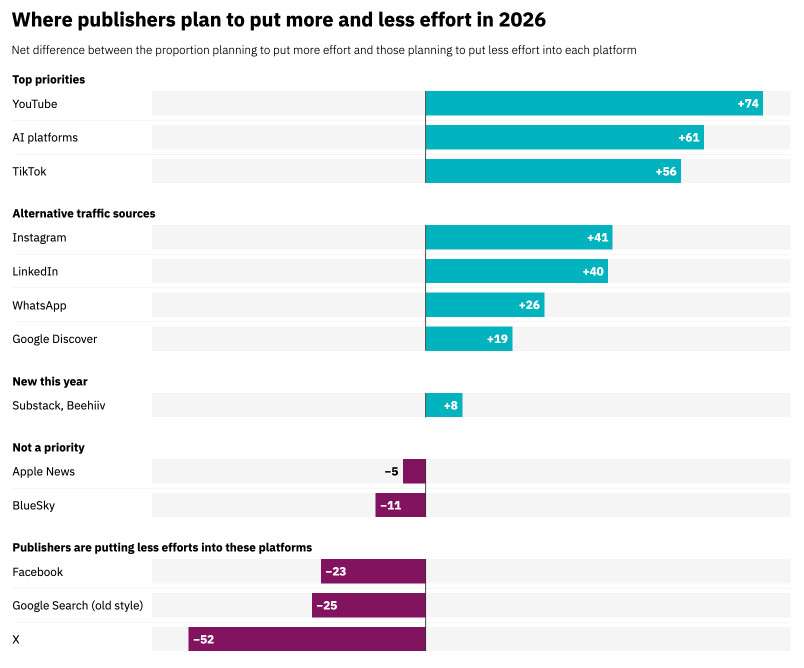
In his 2026 priorities letter, YouTube CEO Neal Mohan noted in January that the platform has paid more than $100 billion to creators, artists, and media companies over the past four years.
Adweek reported that journalist-creators like Tara Palmeri, Taylor Lorenz, and Dave Jorgenson are now treating YouTube as their primary distribution point, using its discovery engine to attract viewers and funneling their most engaged fans toward Substack and Patreon for conversion.
✧
Measurement Innovation
Piano.io provides a publisher engagement platform that moves newsrooms away from raw traffic metrics toward what they call the “engagement ladder.” Its system tracks how readers progress from anonymous visitors to registered users to paying subscribers.
Among the publishers using Piano.io include Rolling Stone, The Atlanta Journal-Constitution, The Boston Globe, and The New York Times. The platform’s 2026 data showing the 110x revenue difference between engaged and casual users is becoming a rallying point for the industry’s shift.
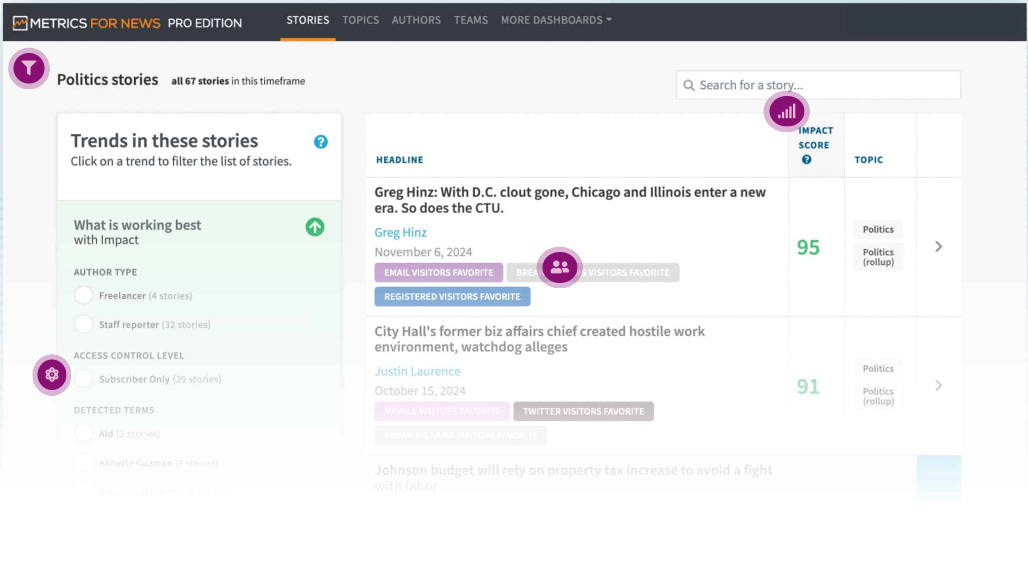
The American Press Institute’s Metrics for News (MFN) tool helps newsrooms measure engagement depth across beats and content types. Newsrooms like the Winnipeg Free Press and Crain’s City Brands use MFN to identify what content their audiences genuinely value — and, critically, what they can stop producing.
🛠️ The Build Opportunities
The gap in the market is wide open — and it’s bigger than a single product. In my opinion, there are at least three distinct build opportunities emerging from the traffic collapse.
✧
Opportunity 1: The Post-Traffic Analytics Platform
What publishers need — and what doesn’t yet exist as a single, integrated product — is a post-traffic analytics platform built specifically for news organizations.
This tool could unify several data streams that are currently siloed: on-site engagement depth (time spent, scroll depth, return frequency), off-platform presence (citations in AI answers, social sharing, newsletter opens), audience identity and loyalty signals (registration, habit formation, community participation), and downstream impact metrics (did coverage drive civic action, policy change, or informed decision-making).
Think of it as Chartbeat meets CRM meets attention scoring. It’s designed for the reality that most of a publisher’s audience may never visit their website directly. The platform could help newsrooms answer the question that traffic never could: Are we actually reaching and serving the people we exist to inform?
✧
Opportunity 2: AI Citation and Distribution Tracking
ChatGPT referrals to publisher websites have risen rapidly since mid-2024. But according to Chartbeat data cited in the Reuters Institute’s 2026 report, ChatGPT still represent just 0.02% of total referral traffic.
As AI platforms grow, publishers need tools that track when and how their content appears in AI-generated answers across ChatGPT, Gemini, Perplexity, Comet, and others. ProRata.ai’s attribution technology is an early example — identifying when publisher content is used, attributing it to its source, and compensating publishers accordingly through a 50/50 revenue share.
To help on that front, IAB Europe released a technical framework in September 2025, titled “Crawling for Compensation,” establishing content access controls, discovery protocols, and monetization APIs. Additionally, IAB Tech Lab’s Content Monetization Protocols (CoMP) working group has developed the standardized APIs to implement these mechanisms at scale.
There’s a clear build opportunity for an independent monitoring layer that gives publishers visibility into their AI footprint — a kind of “Chartbeat for chatbots.”
✧
Opportunity 3: Creator-Newsroom Partnership Infrastructure
The Reuters survey found that 76% of publishers plan to encourage journalists to behave more like creators, 50% plan to partner with external creators for content distribution, and 39% fear losing top editorial talent to the creator ecosystem.
The Washington Post’s Ripple project, CNN Creators, and Vox Media’s creator deals are early experiments. But there’s a gap for tools that help newsrooms manage creator partnerships: revenue-share tracking, brand-safety frameworks, cross-platform analytics for journalist-creators, and talent retention structures that let journalists build personal brands without leaving the organization.
Think of it as a creator management platform built for newsrooms. (See my previous newsletter edition.) As Morning Brew CEO Robert Dippell told Adweek: “Human connection becomes a premium channel” in an AI-saturated environment. The publishers and entrepreneurs who build the infrastructure for that connection will define the next era of news.
✧
For developers and entrepreneurs in the news technology space, this is a rare moment where an entire industry’s measurement and distribution infrastructure needs to be rebuilt simultaneously. The publishers who adopt new metrics and own their distribution first will have the clearest picture of their actual audience — and the strongest pitch to advertisers, funders, and subscribers.
💬 Closing Provocation
The question for every newsroom isn’t how do we get our traffic back? It’s what were we actually measuring — and what should we measure now?
“No discussion of tech media can get past this basic traffic fact: in the AI world, Google and social no longer refer traffic, which means that the vast majority of readers just never find you in the first place.” — Danny Crichton, Partner at Lux Capital and former Managing Editor of TechCrunch
⚡️ tl;dr
Web traffic — the metric news publishers have relied on for 20 years — has collapsed, with some major sites losing 85–97% of their search traffic as Google and Facebook pulled back from sending visitors to news sites. That traffic is now being absorbed by AI answers and walled-garden feeds.
The twist: traffic volume was never a great measure of success anyway. Publishers who shifted early to direct audience relationships (newsletters, subscriptions, YouTube) are actually growing. Data shows highly engaged users generate 110x more revenue than one-off visitors.
The big takeaways: stop measuring pageviews, start measuring engagement and loyalty, and build distribution channels you actually own (like email newsletters) instead of renting audiences from platforms. There are also major opportunities to build new analytics tools, AI citation tracking, and creator-newsroom partnership infrastructure to replace the old, broken system.
It’s a great piece, Luis. Seeing our work at the American Press Institute mentioned—specifically Metrics for News—really hits on the core of what we’re trying to solve.
The collapse of referral traffic isn’t just a data problem. It’s a structural failure of how we’ve defined "success" for twenty years. We spent all that time optimizing for algorithms and renting audiences from platforms that never really cared about the mission. Now that the rent is due and the platforms have moved on, the industry is finally having to reckon with the fact that a page view isn't a relationship.
In my "Backstory & Strategy" writing, I talk a lot about this shift from being a vendor of content to being a partner in the community. If you want someone to stick around as a member or a subscriber, you aren’t just selling them information. You’re asking for their trust. That makes trust a primary financial metric, not just a nice sentiment in a mission statement.
The move toward measuring impact—the kind of reporting that actually changes a law or solves a neighborhood problem—is the only way forward. It’s about being indispensable. At the American Press Institute, we’re helping newsrooms use MFN to identify exactly what their audiences value so they can stop producing commodity noise and start building something that lasts.
If you're wrestling with how to navigate this shift or just want to nerd out on how we're using MFN to make it happen, my door is always open. I’d love to hear what you’re seeing on your end.
I don't believe that digital media companies didn't know—or at least have an idea—that at some point Search and Social Networks would stop pumping easy traffic to their websites. They just decided to spend all their efforts on traffic growth and don't make even minimum amount of work to insulate their business from future problems. It was a lot easier, and the investment market valued that way of growth. We should not feel sorry for this kind of business.