

This newsletter is free and will stay free. If it’s useful to you, a paid subscription is the best way to keep it going. —Luis G.

Newsrooms keep producing journalism their audiences largely skip, then wonder why people tune out.
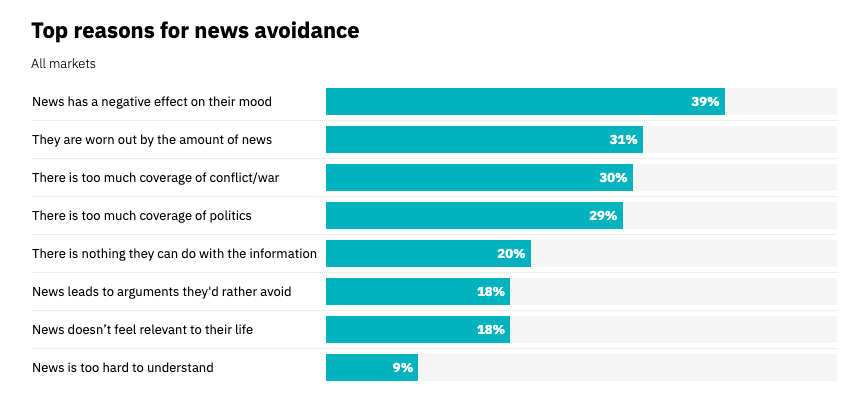
Forty percent of people worldwide now sometimes or often avoid the news, up from 29% in 2017, according to the Reuters Digital News Report 2025. They cite negative mood, information overload, too much conflict coverage, and a feeling that nothing they read helps them act.
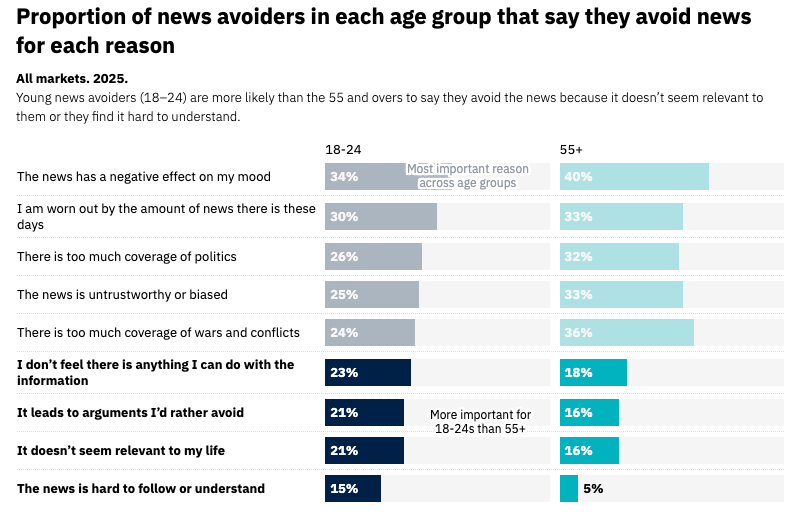
Among 18-24s, the disconnect runs deeper. A Reuters Institute report published in 2026 found that many young adults consider traditional news irrelevant, hard to understand, or biased against their demographic.
And let’s not forget the most obvious form of content that nobody wants to read: commodified news. (Read this great piece on commodified news by Steven Wilson-Beales on Substack.)
And yet, none of this is new information.
In 2016, indie media advisor Dmitry Shishkin and his team at the BBC World Service found that 70% of one outlet’s editorial output was breaking news updates, and that content generated just 7% of its website visits. That finding went public in 2017.
Nearly a decade of audience research has since confirmed the pattern: people want more from news than updates, and the frameworks to deliver on that exist. In my view, few U.S. newsrooms have put any of it into practice though the reasons could vary from outlet to outlet.
But the bottom line is that the longer newsrooms continue to ignore where audiences place their purchasing interests, the longer they’ll continue to miss their revenue goals.
🩺 The Pain Point
The industry’s default mode has historically been top-down: editors decide what matters, reporters write it, and the audience is expected to show up. Newsrooms produce content based on editorial instinct, not audience need, and the mismatch is measurable.
A CJR/Tow Center study on how journalists imagine their readers found that while most newsroom decisions are made with a reader in mind, consciously soliciting and incorporating audience preferences is usually resisted. Journalists recognize obligations to reach an audience but are wary of allowing readers to shape what gets covered.
When the news industry has talked about “empathy” in recent years, the conversation has centered on three things: 1) how reporters relate to sources during interviews, 2) how newsroom leaders support staff through trauma and mental health challenges, and 3) how coverage represents marginalized communities.
The American Press Institute’s 2018 study on the empathetic newsroom focused on reporting techniques for covering neglected communities.
That work has value. But what remains largely unaddressed is the person consuming the product and whether the newsroom is measuring what that person actually needs. In my view, that’s the true empathy gap the industry has been slowest to confront.
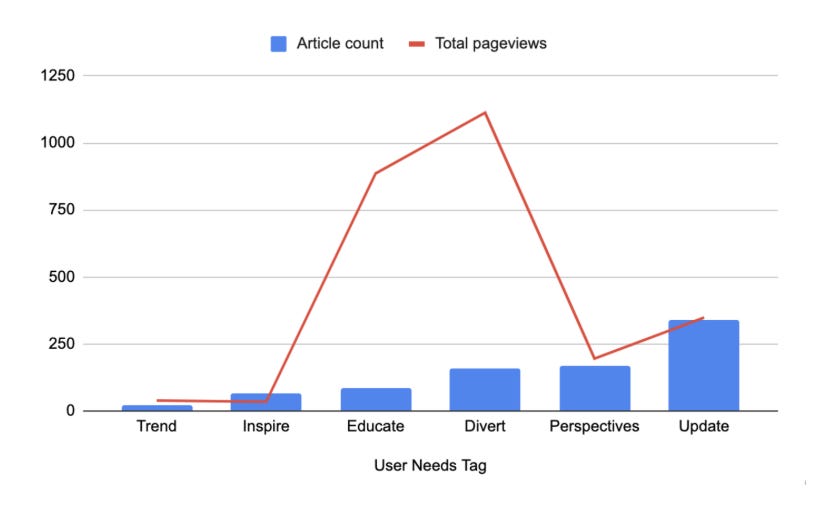
When FT Strategies tested the user needs framework with three U.K. publishers, all three over-indexed toward breaking news updates. One found that 40% of its articles were “update me” pieces driving only 13% of page views, while “divert me” content made up 19% of articles but pulled 43% of traffic.
These were small, U.K.-based experiments — take it or leave it, American colleagues — but the pattern is consistent with what audience surveys keep surfacing globally. And that is newsrooms spending resources on content their audiences skip past, while underinvesting in explainers, service guides, perspective pieces, and stories that help people act.
🔴 Pain Point Score: HIGH
This affects every part of the operation: editorial strategy, resource allocation, revenue, and retention. With AI now commoditizing “update me” content at scale, newsrooms that haven’t rebalanced their output face an existential squeeze.
If the future of news is truly to be built and made by humans, then it should be done with humans in mind, not algorithms or bots.
📊 Why It Matters
Here’s what makes this pain point so frustrating: the audience isn’t being quiet about what it wants.
The Reuters Digital News Report 2025 found that 12% of under-35s in the U.K. avoid news because they don’t understand it. That’s four times the rate among over-35s. The same report found that people want journalists investigating powerful people and providing depth, not chasing algorithms for clicks.
A 2026 Reuters Institute report on young audiences later went even further by pointing out real alienation among 18-24s who find traditional news irrelevant, hard to follow, or slanted against their demographic.
A recent Knight Lab/FT Strategies NGN2 study picked up the same signal from the production side. Yes, young news consumers are engaged. Yes, they care about the news. But they’re drowning in the volume and complexity of what’s out there.
Lisa MacLeod, director of news at FT Strategies, said the most effective producers are rethinking how news is made and delivered, building distribution into editorial decisions from the start rather than bolting it on after publication.
None of this is abstract.
Only 18% of people across 20 wealthier countries pay for online news, and that number has barely moved. An INMA analysis of subscription stagnation identified “not addressing core reader needs” and a “perceived lack of value” as two of the seven reasons growth has slowed.
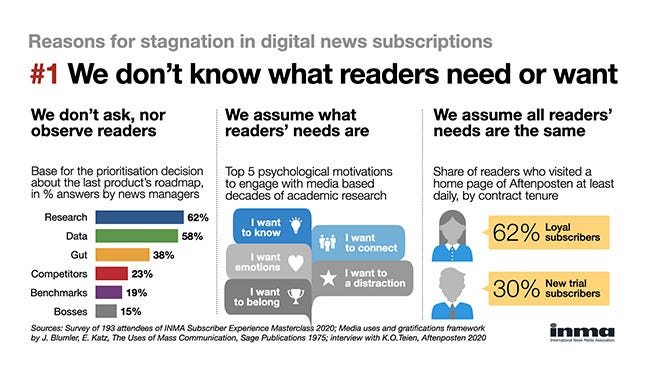
In a 2020 INMA poll cited in that analysis, 38% of news managers said they made product decisions based on gut feeling over research or data. Meanwhile, online reach for the median news brand fell 12% year-over-year in 2025, according to INMA benchmarking of 289 publishers.
As I’ve written before, traffic from search and social media keeps declining. Audiences who feel alienated from the product don’t subscribe, don’t return, and don’t engage with the civic reporting that newsrooms say justifies their existence.
Take the The Washington Post, for example, which lost more than 300,000 digital subscribers in a matter of days after its October 2024 endorsement decision. That was a trust failure, not a content-mix failure. But it showed how fast an audience leaves when it decides a news organization doesn’t represent its interests.
The slower version of the same exit is happening across the industry, and the content-audience mismatch is accelerating it.
🤔 Who Should Care
» Newsroom leaders making editorial strategy decisions.
» Engagement and audience editors who sit downstream of those decisions and are often asked to optimize distribution for content that was never designed around user needs.
» Developers building editorial analytics and CMS tools.
» Independent publishers trying to compete with AI-generated news updates.
🏗️ The Structural Root Cause
The editorial judgment model that drives most newsrooms was built for a supply-constrained environment.
When people had one newspaper and three TV stations, editors could reasonably decide what mattered. That gatekeeping role carried real authority. But it also embedded assumptions that newsrooms never revisited as the information environment changed.
Engagement teams, where they exist, sit downstream of editorial decisions. They optimize distribution for content that was never designed around audience needs. Dmitry Shishkin has argued that this arrangement has persisted for far too long, with audience engagement treated as a side initiative rather than a central purpose of journalism.
The Reuters 2026 trends report found that publishers are now deliberately deprioritizing commodity content and general news, where AI poses the greatest competitive threat, and shifting investment toward original investigations and contextual analysis.
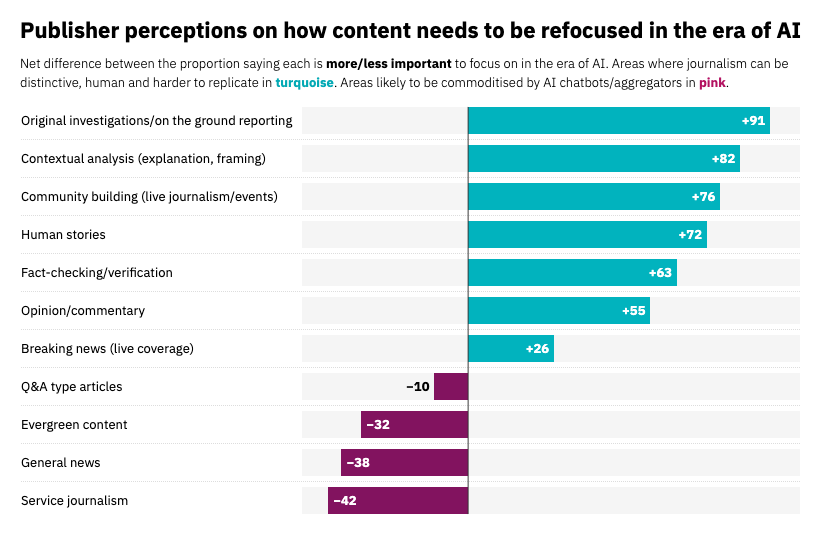
That pivot makes sense as a competitive strategy against AI-generated updates. But if “distinctive journalism” is still defined by what editors believe is distinctive rather than what audiences find useful, the result is the same mismatch at a higher production cost.
Lilly Workneh of PushBlack wrote in Nieman Lab’s 2026 predictions that legacy outlets cut diversity teams, eliminated community beats, and gutted cultural coverage, treating that work as expendable when it was the connective tissue between journalism and community.
This one line from Workneh’s Nieman Lab prediction stuck with me the most because it neatly encapsulates the essence of having a diversity of thought inside a newsroom: “people will always choose the storytellers who choose them back.”
💡 Who’s Solving It (+ How)
The outlets making progress on this problem share one thing in common: they stopped guessing what their audiences want and started asking. Some are using structured frameworks to audit their editorial output against actual engagement data. Others are going straight to their communities through SMS, WhatsApp, and direct questions.
The tools and methods vary, but the shift is the same. They’re going from producing news for an imagined audience to building it with a real one.
✧
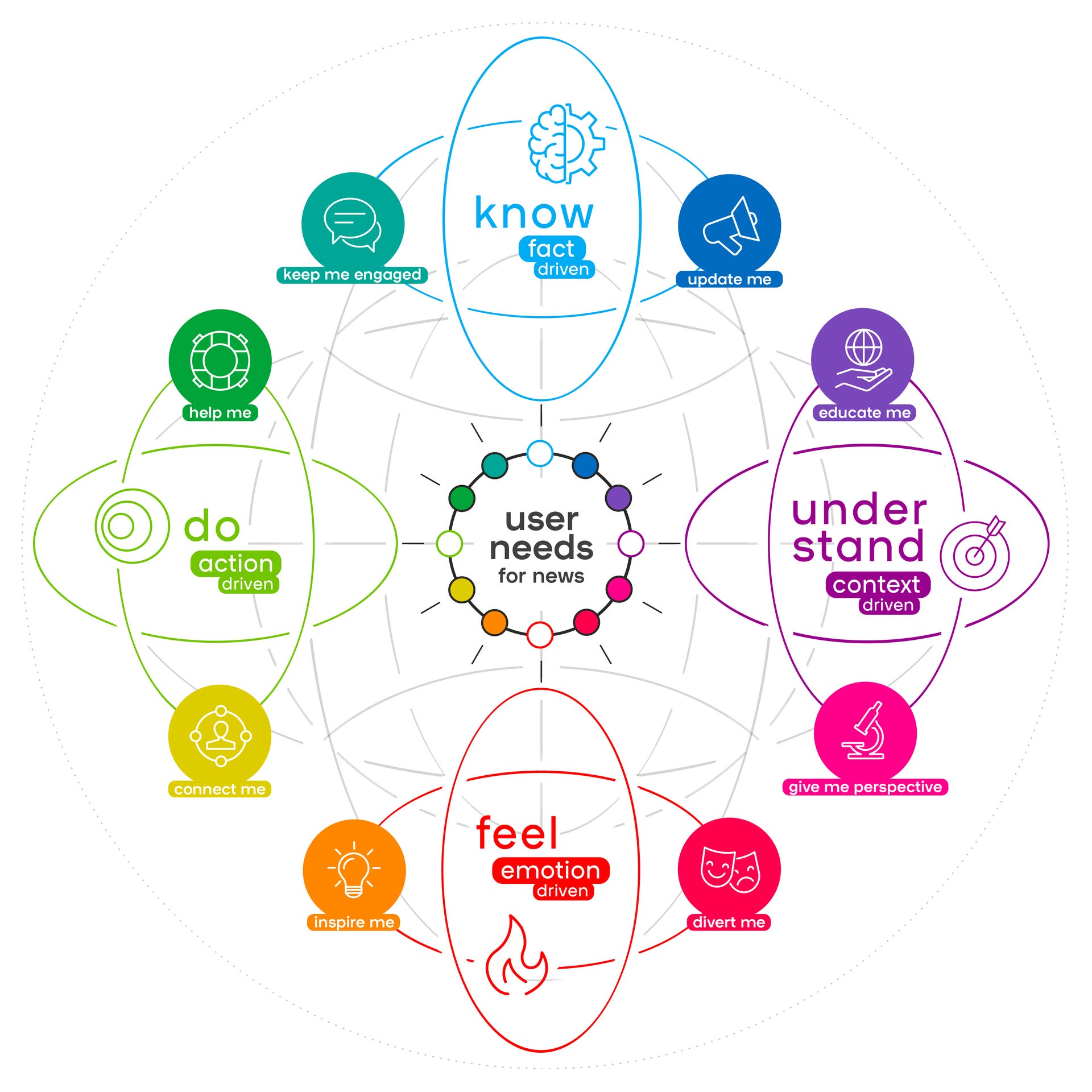
So what does it look like when a newsroom actually tries to fix this? The user needs framework, developed by Shishkin and Smartocto, is the most concrete tool available out there. It organizes news consumption around four drivers — know, understand, feel, do — with eight editorial categories underneath them.
The point isn’t to memorize the taxonomy. The point is that it gives editors a way to audit their output against what audiences actually engage with, and the results are consistent: too much breaking news, not enough of everything else.
Some newsrooms have already put it to work. Omroep West, a Dutch regional outlet, went through Smartocto’s User Needs Labs 2.0 and reported more returning visitors, better engagement, and higher attention time after shifting its content mix.
BauernZeitung, a Swiss agricultural publication, found that 90% of its output was fact-driven or context-driven. When it added more emotion-driven stories, the top performer in that category pulled 15% higher page views, and emotion-driven content brought in 45% new visitors. Smartocto and FT Strategies have since launched User Needs Labs 3.0, a year-long program now enrolling 10 to 15 news brands.
✧
In the U.S., the examples are smaller but instructive. KPCC/LAist asked audiences during COVID what they wanted to know. They got more than 4,000 questions and found sources and stories they wouldn’t have found otherwise.
Nuestro Estado in South Carolina moved to WhatsApp and SMS after realizing its assumptions about community needs were coming from the newsroom, not the community. El Tímpano in Oakland and Outlier Media in Detroit deliver critical information by text message, reaching people where they actually are.
✧
FT Strategies and WAN-IFRA recently launched a global Future Newsrooms Study, surveying editors-in-chief and newsroom strategists on how their organizations are adapting. The findings are expected this summer.
I’ll be watching for how many of those surveyed have actually built audience feedback into their editorial process versus how many are still running on instinct.
🔧 The Build Opportunity
The research, the frameworks, and the case studies all exist. What’s missing is the connective tissue between them and the newsrooms that need them most.
The tools that make user needs actionable are either expensive, Europe-based, or designed for publishers with dedicated data teams. Small U.S. newsrooms and independent publishers — the ones getting squeezed hardest by the content-audience mismatch — are locked out of the very infrastructure that could help them fix it. That’s where the build opportunities are.
✧
Opportunity 1: User-Needs Dashboard
Smartocto is the primary tool doing this work right now, but it’s Europe-based, geared toward mid-to-large publishers, and priced accordingly. No lightweight, U.S.-focused equivalent exists.
The opportunity is a simple editorial analytics layer that sits on top of a newsroom’s existing CMS and does three things: tags output against user needs categories (automated with AI), measures performance against those tags, and generates weekly rebalancing recommendations. The reporting doesn’t need to be complex.
A dashboard that tells an editor “you published 65% ‘update me’ content this week and it drove 11% of your engaged traffic, while your three ‘help me’ pieces drove 28%” would give a 10-person newsroom the same strategic visibility the BBC and FT have had for years. Nothing like this exists in the U.S. market at an accessible price point.
✧
Opportunity 2: Editorial Audit Tool for Newsletters
Most solo operators and small outlets running newsletters make content mix decisions by gut — the same instinct-over-data approach that INMA found among 38% of news managers industrywide.
A tool built on user needs categories that lets an independent publisher tag their newsletter output, benchmark category performance over time, and see where their mix is off would fill a gap no one is currently addressing. The bones of this could be built on top of existing platforms like Substack or beehiiv, using AI-assisted tagging and a lightweight reporting layer.
The market for it is large and growing: Substack alone hosts over 50,000 publications earning money, and most of them are flying blind on editorial strategy.
💬 Closing Provocation
“I believe that journalism as an industry has lost its way because the economics are so dire, and they have been for so long. We urgently need to acknowledge this and reset course. We need to move back our focus to the quality of the products and the experiences that we create for the people we aim to serve.” — Mattia Peretti, co-founder of the News Alchemists and a former leader of JournalismAI, at an ICFJ forum.
⚡️ tl;dr
Newsrooms overwhelmingly produce breaking news updates that their audiences skip, while underinvesting in the explainers, service journalism, and perspective pieces people actually want.
The data proving this has existed since 2016, and frameworks like the user needs model offer a tested fix.
But most U.S. newsrooms haven’t adopted any of it — and the cost shows up in stagnant subscriptions, declining reach, and growing audience alienation, especially among younger readers.
Two build opportunities could help close the gap: a lightweight editorial analytics dashboard for small newsrooms, and a content-mix audit tool for independent newsletter publishers.
Excellent insights. I’ve explored some of them here: https://technewstt.com/bd1559-reuters-report-young-news-readers/
I’ve been reading through some of your posts and love the detail in them, and how you structure it as well. I wish the editors and powers-that-be that run the actual news outlets read some of this.